Cart
0
What makes a piece rare? How rarity is measured in handmade crafts
What makes a handmade piece rare? I explain the criteria we use (how many hands still make it, technique, time, raw material) and the five levels of the Ra‑Ro Index, with real examples.

In this article
 By Tiago Reis, co-founder of Ra‑Ro · View profile
About an 8 minute read

There is a question I hear almost every week, at a fair, by email or around a dinner table: "but why is this rare?". It is a fair question. Rare is a word that wears out quickly, and in the craft world almost everything is sold as "unique" or "exclusive". When we founded Ra‑Ro, we felt we needed an honest way to answer it, piece by piece.
A handmade piece is rare when few hands still know how to make it, when it follows an almost forgotten technique and when it comes from a slow process that cannot be rushed or mass-produced. At Ra‑Ro we measure this with the Ra‑Ro Index, a five-level scale: Uncommon (Invulgar), Scarce (Escasso), Rare (Raro), Very Rare (Raríssimo) and Unique (Único).
What makes a piece rare?
Rarity is not a label. It is the sum of several things you can ask the person who made the piece. These are the ones that weigh most in my eyes when I meet an artisan:
- How many hands still make it. Isidoro Ramos, from Paderne, is one of the few artisans in Portugal who still harvests esparto grass in the inland hills of the Algarve. When a skill depends on a handful of people, every piece counts.
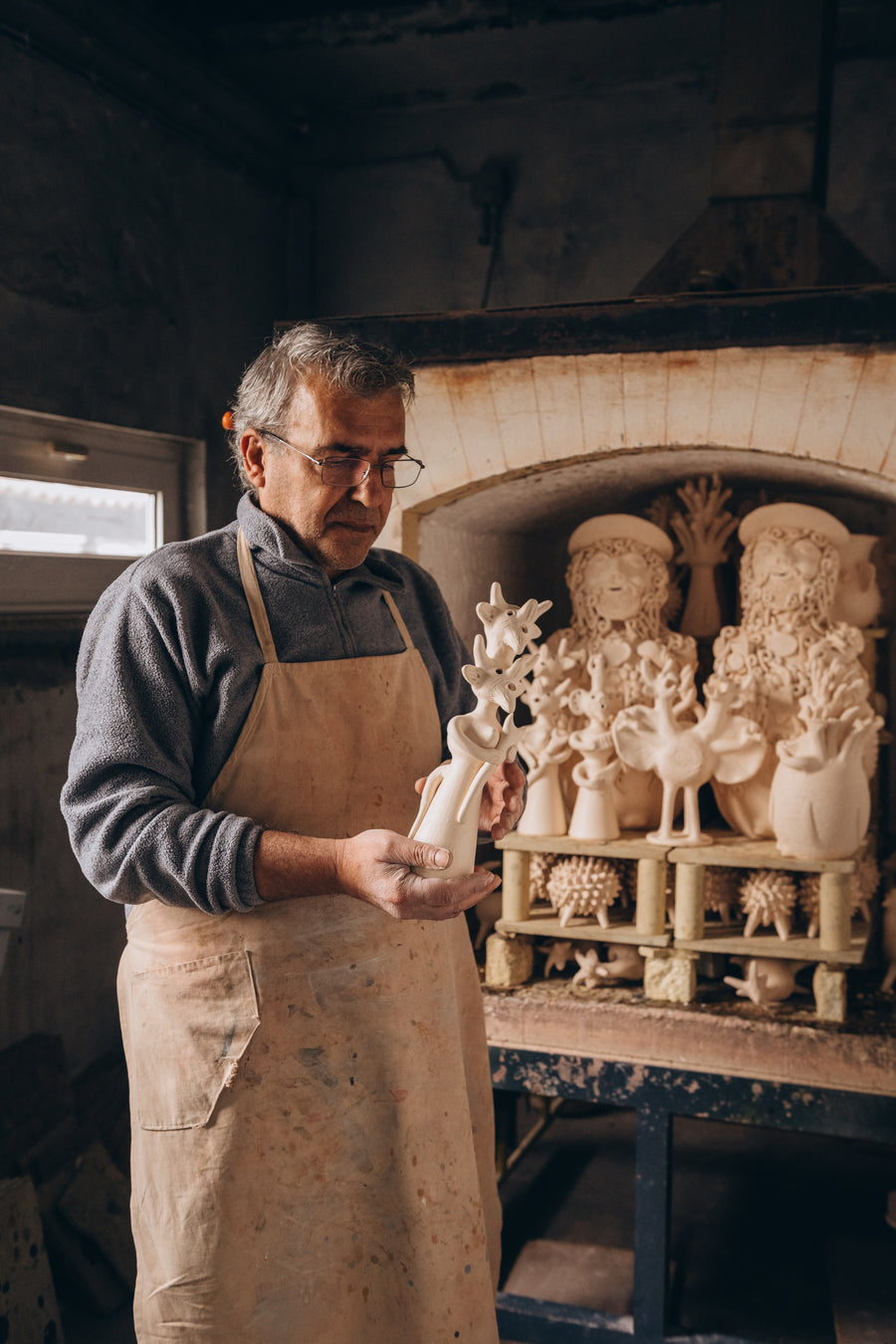
- The technique. Some techniques are mastered by almost no one. César Teixeira, in Gondar, shapes clay on the low wheel, a horizontal hand-turned wheel, and fires it by soenga, a pit-firing method.
- Time. Esparto sprouts between April and May, is pulled up between July and September, dries in the sun, is soaked and only then braided. There are no shortcuts.
- The raw material. Andreia Pinho does not buy clay: she digs it by hand in different corners of Portugal. The cobertor de papa blanket needs wool from the churra sheep. When the material is hard to get, so is the piece.
- Seasonality. The bulrush (bunho) that Helena Novelletto weaves is gathered once a year, in July and August. Fleur de sel only forms when conditions are just right.
- Heritage status. Being listed in a national inventory or by UNESCO does not make a piece rare on its own, but it tells us that a community recognised that knowledge as its own and, sometimes, that it is at risk.
- One-off or repeated. Every handmade piece varies slightly from one to the next. It is something else when a piece will never be made again, or is the last one from a production that has stopped.
How is rarity measured in the Ra‑Ro Index?
The Ra‑Ro Index is the rarity scale we created to show how special each handmade piece we sell is. It looks at three criteria:
- Quantity: how many exist? Whether the piece exists in small numbers, made by small businesses and small productions.
- Technique: how is it made? Whether it follows an almost forgotten technique, kept alive by few artisans.
- Time: how long does it take? Whether it comes from a slow process that cannot be rushed or mass-produced.
On every product page the level appears as a small scale of five squares. The more squares are filled, the rarer the piece. The three criteria are read together, piece by piece, not as a simple sum.
What are the levels of the Ra‑Ro Index?
There are five, from the most accessible to the hardest to find. The table shows what each level means and a real example from our catalogue.
| Level | What it means | Example at Ra‑Ro |
|---|---|---|
| 1. Uncommon (Invulgar) | You may have heard of it and even seen it somewhere, but not everywhere: it comes from small businesses and small productions. | Onion Chorizo, Quinta dos Fumeiros (Ponte de Lima) |
| 2. Scarce (Escasso) | You will not find it round the corner. There are still local shops and some active artisans, but it may be seasonal or depend on raw materials. | Fleur de Sel, Salinas do Samouco; cork Barcelos Rooster, Porfírio Mendes |
| 3. Rare (Raro) | Not easy to find, but possible. A few artisans remain and there is some risk it will disappear. | Spiral Basket, AECT (Tavira); Mafarrico, Andreia Pinho |
| 4. Very Rare (Raríssimo) | You will hardly find it. Production is limited or at risk and probably only a few artisans are left. | Esparto Barreleira, Isidoro Ramos; Gondar black clay, César Teixeira |
| 5. Unique (Único) | On the verge of no longer being sold. There may be no active production left, or it is one of a kind and impossible to reproduce. | Blankets by O Genuíno Cobertor de Papa; Vinho dos Mortos (Boticas) |
What is the difference between Uncommon and Scarce?
An Uncommon piece is already out of the ordinary, but you can still find it. The Onion Chorizo from Quinta dos Fumeiros, in Ponte de Lima, is a good example: a smoked sausage from a family house that Deolinda Campelo took over from her mother, Aurora. It is not everywhere, but it exists, and it is a pleasure to come across it.
A Scarce piece is no longer round the corner, and it often depends on nature or on the season. The Fleur de Sel from Salinas do Samouco is gathered by hand, with nets, at Marinha do Canto in the Tagus estuary, and only appears when conditions allow. The Barcelos Rooster by Porfírio Mendes is Scarce too: the rooster is everywhere, but carved in cork, at night, after a day on a building site, it is not. The same goes for the Cavaquinho by Diogo Valente of Instrumentos Valente, worked by hand from start to finish.
When does a piece become Rare?
It becomes Rare when only a few artisans remain and there is some risk that the knowledge will disappear. The Spiral Basket from AECT, in Tavira, is made by women aged between 70 and 80 who weave dwarf palm using the empreita braiding technique. Fifty years ago it was common for farmers to make their own palm baskets to gather potatoes and carob. Today it takes an association to keep these hands at work.
The Mafarrico devil by Andreia Pinho is also Rare, and here the raw material weighs most: wild clay she digs herself, never the same from one place to the next. It is a mafarrico from a single ceramicist, in her own language and her own clay.
What makes a piece Very Rare?
A Very Rare piece is hard to find: production is limited or at risk and probably only a few artisans are left. The Barreleira by Isidoro Ramos ticks almost every box at once. The esparto grows in the Algarve hills, is pulled up by force, dries in the sun until it turns golden, is soaked and only then becomes braids, coiled and stitched with a thick needle and jute or sisal cord. Isidoro learned from his grandmother and his mother, went back to esparto after retiring and now shares the craft in workshops. His Caracoleira snail basket and Donkey Head sit at the same level.
The Gondar black clay of César Teixeira is another case. At 18, César learned the low wheel and soenga from master potter Manuel Teixeira, and in the story we tell on his page he is presented as one of the last soenga masters still working. His son João has joined him, and together they hold public soenga firings. Gestures like these are why a Very Rare piece is not yet Unique. Helena Novelletto, one of the last bulrush weavers still working in Portugal, is another example of knowledge that hangs on very few hands.
What does a Unique piece mean?
Unique is a piece on the verge of no longer being sold, because there may no longer be any active production, or because it is one of a kind and impossible to reproduce. It is the level I least like to give, because it almost always tells a story of loss.
The cobertor de papa is the example that moves me most. When the José Freire factory closed in 2013, the blanket went extinct. In 2018, Céu Reis and 15 other partners founded the association O Genuíno Cobertor de Papa, rescued a hand loom around 300 years old and started weaving again, in Maçainhas, near Guarda. Today it is the only certified team still making it. Among traditional products, the Vinho dos Mortos from Boticas is Unique as well: according to family history, it was born from bottles buried to hide them from Napoleonic troops, and today it has a single producer, Nuno Pereira.
Does heritage status make a piece rare?
Not always, but it is a sign worth reading. The Barcelos clay figures (figurado) were entered in Portugal's National Inventory of Intangible Cultural Heritage on 10 July 2026. The file mentions about 50 active artisans, in a community of around 100 people, with production all year round. It is recognised, living knowledge, and that is not the same as being at risk.
In other cases, recognition comes precisely because the knowledge is disappearing. In 2016, the Bisalhães black pottery manufacturing process was added to UNESCO's List of Intangible Cultural Heritage in Need of Urgent Safeguarding. UNESCO explains that it is passed on almost exclusively through family ties and that its future is in jeopardy because of a diminishing number of bearers, waning interest from younger generations and demand for industrial alternatives. That is exactly the kind of fragility the Index tries to make visible.
How can you tell if a piece is rare?
You do not need to be an expert. Just ask the right questions before you buy:
- Who made this piece, and how many people still know how to make it?
- Does the technique have its own name, like soenga, empreita or the low wheel?
- Where does the raw material come from, and in which season is it gathered?
- How long does it take, from raw material to finished piece?
- Is the craft recognised in an inventory, by a certification or by UNESCO?
- Are there dozens of identical pieces with no maker's name? Then be wary of "rare".
At Ra‑Ro, every piece carries the name of the person who made it and its level on the Ra‑Ro Index. It is our way of answering the question before it is asked.
Frequently asked questions
What is a rare piece in handmade crafts?
It is a piece made by few hands, with an almost forgotten technique or a slow process that cannot be industrialised. Scarce raw materials and seasonal production also count.
How can you tell if a piece is rare?
Ask who made it, how many people still master the technique, where the raw material comes from and how long it takes. At Ra‑Ro, the Ra‑Ro Index shows each piece's rarity level on a scale of five squares.
What are the levels of the Ra‑Ro Index?
There are five: Uncommon (Invulgar), Scarce (Escasso), Rare (Raro), Very Rare (Raríssimo) and Unique (Único). Each level reflects how many exist, the technique used and the production time.
What is the difference between Rare and Very Rare?
A Rare piece is not easy to find but possible, and a few artisans remain. A Very Rare piece is hard to find: production is limited or at risk and probably only a few artisans are left, as with Isidoro Ramos's esparto or Gondar black clay.
What does Unique mean on the Ra‑Ro Index?
It means the piece is on the verge of no longer being sold, because there may be no active production left, or that it is one of a kind and impossible to reproduce. The cobertor de papa blanket and Vinho dos Mortos are examples.
Does heritage status make a piece rare?
Not automatically. The Barcelos clay figures are in Portugal's National Inventory of Intangible Cultural Heritage and have about 50 active artisans. Bisalhães black pottery, on the other hand, is on UNESCO's urgent safeguarding list because the number of bearers is shrinking.