Cart
0
Endangered crafts in Portugal: rare techniques that still survive
Which Portuguese craft techniques are at risk of disappearing, which are on UNESCO's urgent safeguarding list and the national inventory, why they fade and what keeps them alive.

In this article
 By Tiago Reis, co-founder of Ra‑Ro · View profile
About a 9 minute read

I have to admit it: there is one question that follows me every time a new piece joins Ra‑Ro. How many people in Portugal still know how to make this? Very often the answer fits on the fingers of one hand. It is a rarity nobody chooses, one that happens because there is no one left to learn, and that is why I love these techniques as much as I worry about them.
Endangered crafts in Portugal include cowbell making, Bisalhães black pottery and the naval carpentry of moliceiro boats, the three Portuguese techniques on UNESCO's urgent safeguarding list, as well as the decoration of Redondo pottery, under urgent safeguarding in the national inventory. These techniques vanish because masters grow old, apprentices are missing and industrial products are cheaper. They survive when people buy them, learn them and record them.
Which Portuguese craft techniques are at risk of disappearing?
The official lists give very clear clues. When UNESCO inscribed the manufacture of cowbells on the List of Intangible Cultural Heritage in Need of Urgent Safeguarding, on 1 December 2015, the file counted 13 craftspeople in 11 workshops, nine of them over 70. The centre is Alcáçovas, in the municipality of Viana do Alentejo, with workshops in other towns too.
In Bisalhães, Vila Real, the black pottery manufacturing process entered Portugal's National Inventory of Intangible Cultural Heritage in 2015, already under urgent safeguarding, and on 29 November 2016 it reached UNESCO's urgent list at a meeting in Addis Ababa. The national record describes six potters, the oldest between 74 and 81, and only one younger.
In December 2025 it was the turn of the moliceiro boat, the art of naval carpentry of the Aveiro region. The documentation quoted in the press speaks of only five active master builders, four of them over 60. In the 1970s there were about three thousand moliceiros on the Ria de Aveiro; today there are fewer than 50.
Some alarms have not yet reached UNESCO. The decoration techniques of Redondo pottery, in Alentejo, were entered in the national inventory in November 2024 under urgent safeguarding. Eight painters and one potter keep them alive.
Which Portuguese crafts are intangible cultural heritage?
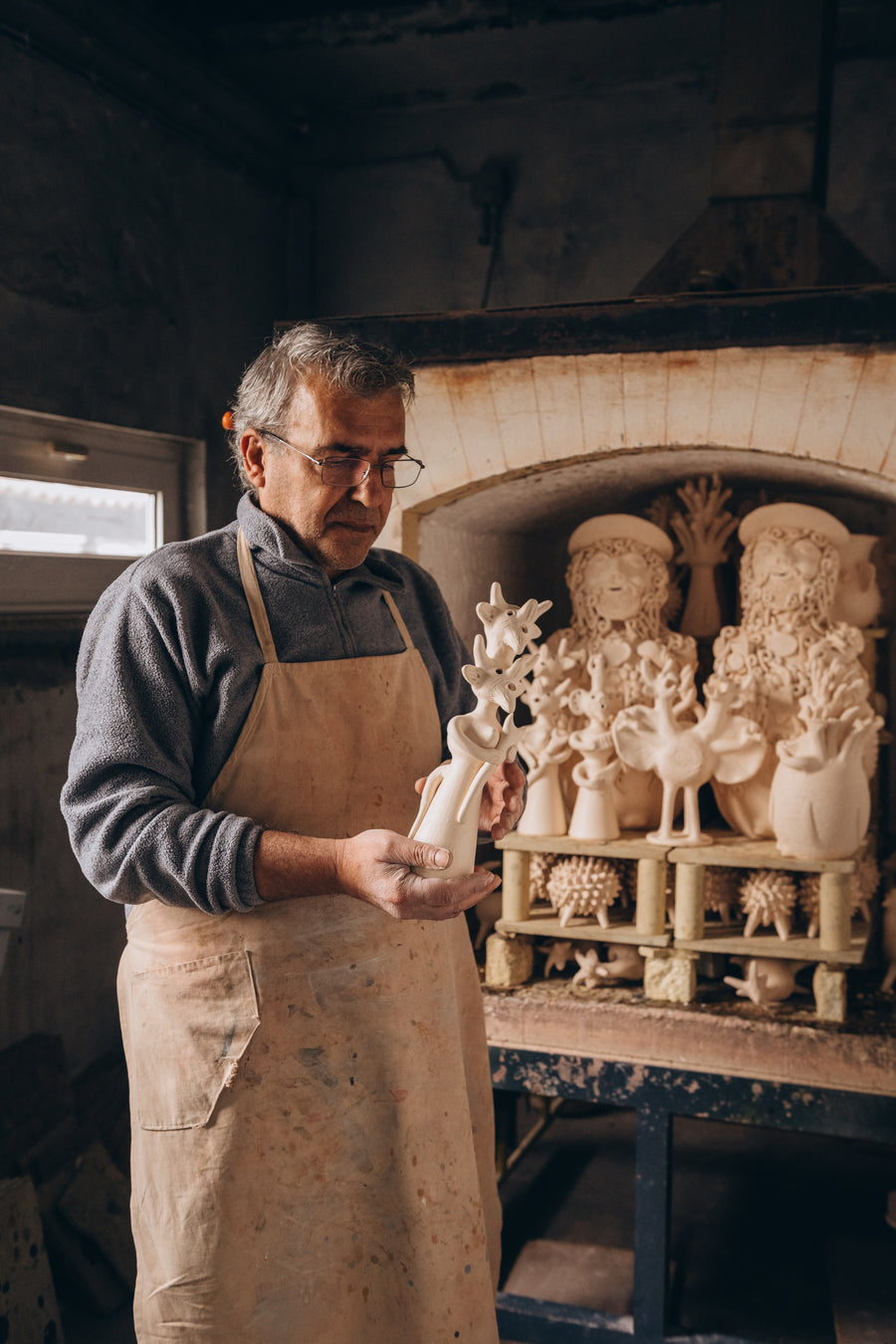
Not all intangible heritage is in danger, thankfully. Estremoz clay figures have been on UNESCO's Representative List since December 2017. Figurado de Barcelos entered the national inventory on 10 July 2026, with about 50 active artisans, and in September 2026 it also gained European protection as a geographical indication for craft and industrial products. The table brings together the techniques I could confirm in official sources.
| Technique | Region | Status | Year |
|---|---|---|---|
| Cowbell making | Alcáçovas, Alentejo | UNESCO, urgent safeguarding | 2015 |
| Bisalhães black pottery | Vila Real, Trás-os-Montes | National inventory (urgent safeguarding) and UNESCO, urgent safeguarding | 2015 and 2016 |
| Estremoz clay figures | Estremoz, Alentejo | UNESCO, Representative List | 2017 |
| Redondo pottery decoration | Redondo, Alentejo | National inventory, urgent safeguarding | 2024 |
| Castelo Branco embroidery | Castelo Branco, Beira Baixa | National inventory | 2025 |
| Molelos black pottery | Tondela, Viseu | National inventory | 2025 |
| Moliceiro boat (naval carpentry) | Ria de Aveiro | UNESCO, urgent safeguarding | 2025 |
| Figurado de Barcelos | Galegos, Barcelos, Minho | National inventory | 2026 |
Portugal's National Inventory of Intangible Cultural Heritage is managed by Património Cultural, I.P., and inscription is usually the first step before a UNESCO nomination. It is not a trophy: it makes a community describe what it does, who does it and how it will pass it on.
Why do traditional craft techniques disappear?
The official files repeat the same reasons, almost word for word. This is how I sum them up:
- Ageing masters. In cowbell making, nine out of thirteen craftspeople were over 70 when UNESCO inscribed it.
- No apprentices. UNESCO mentions the waning interest of younger generations in Bisalhães, and in Castelo Branco the embroidery file points to the small number of embroiderers and little demand for training courses.
- Industrial competition and price. Plastic and aluminium replaced clay pots in the kitchen, and a handmade piece has to compete with mass production.
- Loss of the original use. Cowbells lost their purpose with new grazing methods, and moliceiros are no longer needed to harvest aquatic plants.
- Hard-to-get raw materials. Esparto grass is pulled up by hand between July and September, and bunho rush is harvested once a year. Without someone to gather it, there is no one to weave it.
I would add one reason that never appears in the files: tiredness. Many of the makers we work with have another job and give their craft the end of the day. A technique that depends on hours stolen from rest is always one step away from stopping.
Which rare techniques still survive?
At Ra‑Ro we work with several people who keep alive techniques that almost nobody masters. Some are not on any inventory, but the rarity is the same.
Soenga and Gondar black clay
In Gondar, Amarante, César Teixeira shapes clay on a low, horizontal, hand-turned wheel and fires it in a soenga, a pit where smothered fire blackens the pieces. He learned at 18 from master potter Manuel Teixeira, works in a former primary school, the same one where he learned to read, and still works at the local hospital by day. The good news is that his son, João, joined him after studying ceramics at ESAD in Caldas da Rainha. Together they run public soengas and workshops. This is Gondar black clay, a cousin of the Molelos pottery, where soenga also survives.
Cobertor de papa in Maçainhas
The cobertor de papa blanket was nearly lost when the José Freire factory closed in 2013. Céu Reis, who had worked there for more than two decades, founded O Genuíno Cobertor de Papa in 2018 with 15 other members and rescued a hand loom about 300 years old. They weave churra sheep wool by hand, with the same weavers from the old factory. Guarda City Council announced in 2019 a process to request its inscription in the national inventory; I have not yet found the inscription published.
Esparto, palm and bunho
In the Algarve, Isidoro Ramos, from Paderne, learned esparto from his grandmother and mother and went back to it after retiring. He is one of the few who still harvest it in the inland hills of the Algarve. His Caracoleira snail basket is made in empreita, braids coiled and stitched from the base up.
In Tavira, through AECT, women aged between 70 and 80 weave palm leaf the way farmers did fifty years ago to gather potatoes and carob. They make the Rug, the Spiral Basket and the Lidded Basket. In Caldas da Rainha, Helena Novelletto, one of the last active bunho weavers in the country, learned from master Manuel Ferreira of Santarém.
Burel and mountain wool
In Manteigas, Ecolã, founded in 1925, was close to closing until João Clara de Assunção came back in 1995. Today it makes burel from Bordaleira Serra da Estrela wool, and that is where the Wool Blanket (Manta Pastor) comes from. In the Montemuro mountains, As Capuchinhas weave on hand looms pieces such as the Light Mélange Burel Coat.
What helps save an endangered craft technique?
There is no magic formula, but some gestures make a real difference:
- Buy direct, or from someone who names the maker. The money reaches the workshop and the piece stops being anonymous.
- Learn and teach. The "Working Copper" workshops by Nuno Palma, a coppersmith in Loulé, and the public soengas of César and João Teixeira put new hands on the craft.
- Record the knowledge. Inscription in the national inventory requires the technique to be documented. In Redondo, the file considers a safeguarding plan with training essential.
- Protect the name. The European geographical indication for figurado de Barcelos stops just any figure from being sold under that name.
- Give it a new life. The embroiderers of Castelo Branco call for dialogue with designers, and As Capuchinhas work with contemporary design by Paula Caria.
That is why at Ra‑Ro every piece carries the name of its maker and a score on the Ra‑Ro Index, from Unusual to Unique. It is not a luxury seal, it is a warning. The higher the score, the fewer hands are left. You can read more about the scale in the Ra‑Ro Index glossary.
Frequently asked questions
Which Portuguese crafts are on UNESCO's urgent safeguarding list?
Three techniques: the manufacture of cowbells (2015), the Bisalhães black pottery manufacturing process (2016) and the moliceiro boat, the art of naval carpentry of the Aveiro region (2025).
What is Portugal's National Inventory of Intangible Cultural Heritage?
It is Portugal's official register of intangible heritage, managed by Património Cultural, I.P. An entry can carry urgent safeguarding status and usually comes before a UNESCO nomination.
How many potters still make Bisalhães black pottery?
The national inventory record describes six potters, the oldest between 74 and 81, and only one younger. In 2016 the press reported five with pottery as their main activity.
What is the difference between Bisalhães, Molelos and Gondar black pottery?
They are three centres of black pottery, darkened by firing without oxygen. Bisalhães is in Vila Real and on the UNESCO list; Molelos, in Tondela, entered the national inventory in 2025 with seven potters; in Gondar, Amarante, César Teixeira uses the low wheel and the soenga.
Is figurado de Barcelos endangered?
It does not have urgent safeguarding status. It was entered in the national inventory on 10 July 2026, with about 50 active artisans and production all year round, and in September 2026 it gained European protection as a geographical indication.
How can I help preserve traditional Portuguese crafts?
Buy pieces that carry their maker's name, ideally direct or from someone who works with the artisan, join workshops, visit the makers and accept paying for the time each piece takes.