Cart
0
Hammered copper: what it is, how it is made, how to clean it and why the cataplana is copper
Hammered copper is sheet copper shaped by hand, blow by blow. How it is made, why it is the metal of the cataplana and how to clean it without damaging it.

In this article
 By Luís Serra, co-founder of Ra-Ro · View profile
About a 5 minute read

There is a question that sounds like it belongs in the kitchen but is really about physics: why is the cataplana made of copper? It could be stainless steel, aluminium, clay. It is not chance, and it is not only tradition. And the answer also explains why almost nobody makes it by hand any more.
Hammered copper is sheet copper that the craftsman shapes by hand, blow by blow, with hammers and supporting forms; the small facets you see on the surface are the marks of those blows. In Portugal it is the trade of the caldeireiros, the coppersmiths, and Loulé, in the Algarve, was for decades one of their towns. It is the metal of the cataplana because it conducts heat very well and spreads it evenly. At Ra-Ro, hammered copper comes from Nuno Palma, a young coppersmith from Loulé who works at the Da Palma workshop.
How is a hammered copper piece made?
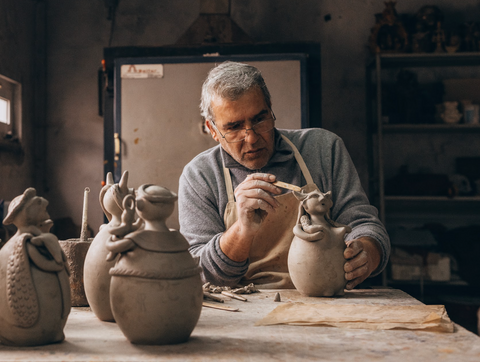
First the sheet is cut to the size and outline of the piece. Nuno Palma cuts the copper sheets he works with himself, which already says something. Then the sheet is beaten over anvils and forms, little by little, until it gains curve and depth. It is slow work, done by ear: the sound of the hammer tells you whether the metal is giving evenly. The last, smaller blows leave the faceted texture and, along the way, compact and harden the metal. Finally handles, clasps or hinges are fitted and the piece is polished.
Which leads to something worth understanding before you buy: no two pieces are the same. The small differences in shape and shine are not a defect. They are proof that someone was there with a hammer, not a press.
In Loulé, the coppersmiths' workshops made pots, chocolate pots, cauldrons and the boilers used for cork and for distilling medronho brandy, in copper and brass. As industrial utensils arrived, they closed one by one, and by the mid 2010s almost nobody in the town still worked copper. Loulé council, through its Loulé Criativo programme, even ran a course in traditional coppersmithing to pass the knowledge on to new hands. That is the context in which Nuno Palma's work matters. It is not nostalgia. He is one of the few people who still know how to do this.
Why is the cataplana made of copper?
The cataplana is a typically Portuguese utensil made of two shells that close over each other; inside, fish, shellfish, meat and vegetables cook in their own steam and juices. Copper heats quickly and evenly, without hot spots, which lets you cook over a medium flame without burning the bottom. In other words, the material is not decoration. It is the reason the cataplana works.
The problem is that most cataplanas on sale today are industrial, and a handmade copper cataplana is very hard to find. The Copper Cataplana by Da Palma is one of them; we tell its story in Hammered Copper Cataplana. A cook's detail: the Flor de Sal from the Samouco salt pans goes in at the end, on top, so it stays crunchy.
There is a nuance many people do not know. Copper reacts with acidic foods such as tomato, wine or vinegar and can pass into the food. That is why copper cooking utensils traditionally have a tinned interior, meaning a lining of tin, a metal that does not react with acids. Tin wears with the years, and a coppersmith can re-tin the piece. It has a low melting point, around 232 °C, so a tinned pan never goes on the heat empty. Before cooking in a copper piece, check what the inside is like; if you have doubts about one of ours, talk to us.
How do you clean copper without ruining it?
Day to day, hot water, mild soap and a soft sponge, then dry straight away with a cloth so no water marks are left. To bring back the shine on the outside, half a lemon dipped in coarse salt, or a paste of vinegar, salt and a little flour, rubbed gently and rinsed well. On a tinned interior, only a soft sponge, and no scraping with metal utensils. Steel wool, abrasive scourers, bleach and the dishwasher are out. Store it somewhere dry, without the lid clamped shut if the piece is still damp.
And the patina? Copper darkens with use and with air. For a long time I saw that as dirt. Today I think it is mostly a matter of taste: some people prefer the shop window shine, others like the warmer tone time gives it. Neither choice harms the piece.
Not all copper goes on the stove. Nuno Palma's Copper Plate is rectangular and works as well on the table as hung on the wall; its story is in Hammered Copper Plate. To take more of the Algarve home, there is our guide The Algarve beyond the beach and the Algarve region page. And from the São Marcos hills, the strawberry tree Bitter Honey, which shares the same spirit: something rare, made slowly.
Frequently asked questions
What is hammered copper?
Copper sheet worked by hand with a hammer, without a press or industrial mould, leaving a surface of small irregular facets.
How do you clean copper?
With hot water, mild soap and a soft sponge, drying immediately. For shine on the outside, lemon or vinegar with salt; avoid steel wool and abrasives.
Why is the cataplana made of copper?
Because copper distributes heat evenly, which lets you cook over a medium flame, in the steam and juices of the food, without burning the bottom.
Is it safe to cook in copper?
Yes, when the interior is tinned, because bare copper reacts with acidic foods. Always check the inside of the piece before cooking.
Can copper go in the dishwasher?
No. Dishwasher detergents and heat stain copper and wear away the tin lining. Wash by hand and dry straight away.
Where can I buy handmade hammered copper?
At Ra-Ro, which sells the cataplana and the plate by Nuno Palma, a coppersmith from Loulé, with shipping to Portugal, Europe, the USA, Canada and Brazil.
 -10%Rare Combinations
 November Selection