Cart
0
Rare crafts in Portugal: the last master artisans still at work
Eight rare crafts in Portugal, from Algarve esparto to the cobertor de papa blanket of Maçainhas, told through the master artisans who keep them alive and the pieces they make.

In this article
 By Tiago Reis, co-founder of Ra‑Ro · View profile
About an 8 minute read

When I say rare, I almost always think of hands. The hands of someone pulling esparto grass in the hills, raking salt on the Tagus, or spending six weeks building a guitar. At Ra‑Ro, rarity is not a pretty adjective to sell things. It is something we try to measure, piece by piece, with the Ra‑Ro Index.
Rare crafts in Portugal are traditional skills that now depend on very few people, such as esparto work in the Algarve, palm weaving in Tavira, burel wool from the Serra da Estrela, building the viola campaniça, traditional salt from Samouco and the cobertor de papa blanket of Maçainhas. They are rare because the raw material is hard to get, the technique takes years to learn and the handover between generations nearly broke. In this article I introduce eight of these crafts and the master artisans we work with.
What makes a craft rare?
For me, a craft is rare when three things come together: few people who know how to do it, a technique you cannot learn in a weekend, and a raw material or a place that cannot be copied. Being old is not enough. The ones that keep me up at night depend on a single village, a single association or a single artisan.
Portugal's national Saber Fazer Portugal programme maps traditional arts and crafts and the artisans who keep them going. The National Inventory of Intangible Cultural Heritage records the practices communities want to safeguard. At Ra‑Ro we add our own Ra‑Ro Index, a 1 to 5 scale (Uncommon, Scarce, Rare, Very Rare, Unique) that tells you honestly how rare each piece is.
Who still works esparto in the Algarve?
Esparto is a native grass of the inland Algarve hills and the Alentejo. It is not cut or harvested: it is pulled out of the ground, between July and September, and that takes strength. It then dries in the sun until it turns a lovely gold, and is soaked to become flexible again before it is braided.
Isidoro Ramos was born in Paderne, in the municipality of Albufeira, and learned the craft as a child from his grandmother and his mother. He spent his working life at a telephone company and, when he retired, went back to the land. Today he is one of the few artisans in Portugal who still gather esparto in the hills, and the Saber Fazer Portugal programme lists him among the country's esparto artisans.
The piece that moves me most is the Barreleira, the basket where laundry waited to be bleached with ash lye, made of esparto braids coiled and stitched by hand from the base to the lid.
What is Tavira palm weaving?
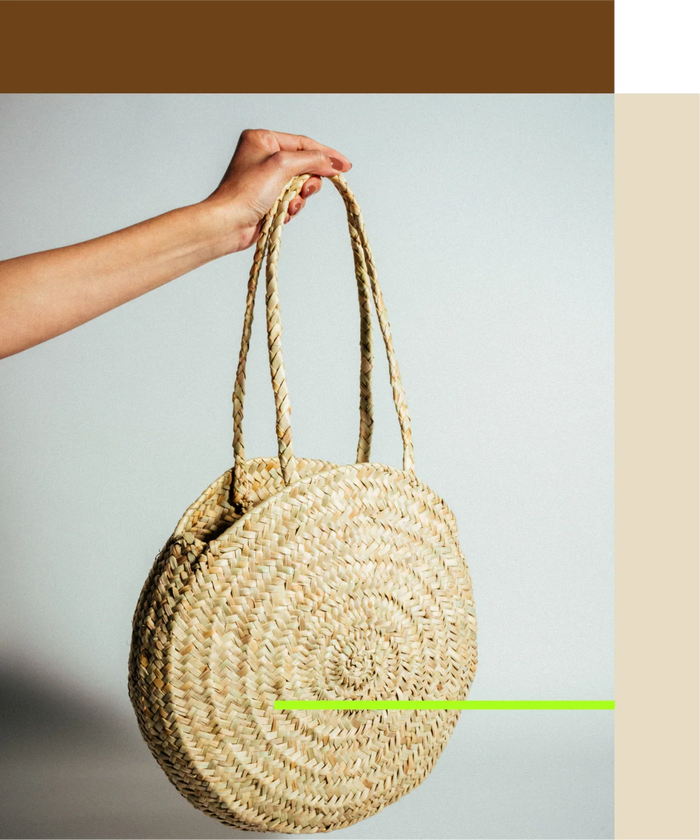
Empreita is the braiding of strips of dwarf palm leaf into long ribbons, which are then sewn together to make baskets, bags and mats. According to the Saber Fazer Portugal programme, it is a cornerstone of the Algarve's material culture, economically important from the 16th century to the middle of the 20th, and done mostly by women, often in winter.
In Tavira we work with AECT, Associação Em Contacto Tavira, which since 2000 has cared for older people and fought isolation through art and tradition. Today the Spiral Basket is woven by women aged between 70 and 80, and some of them still work in the fields every day. Here, rarity has a face and an age.
Why is Serra da Estrela burel rare?
Burel is a wool cloth from the Serra da Estrela, woven on the loom and then fulled, beaten and scalded until it becomes dense and almost waterproof. It was the fabric of shepherds' capes. It is rare because it needs wool from native breeds, a slow process and people who know how to do it.
In Manteigas, Ecolã was founded in 1925. João Clara de Assunção, an economist, came back from Lisbon in 1995 to save the family business from extinction, and today works with the fourth generation, his daughters, as partners and artisans. Everything revolves around Bordaleira Serra da Estrela wool. The Wool Blanket (Manta Pastor) is made with raw wool in the sheep's natural colours: white, beige or brown.
Who keeps the hand looms of the Serra de Montemuro going?
In the 1980s, when emigrating was often the fate of young women from the interior, four friends from Campo Benfeito, in the Serra de Montemuro, took a dressmaking course and decided to stay. They founded the cooperative As Capuchinhas, named after the capucha, the cape shepherds wore against the cold and rain.
They weave linen, wool and burel on hand looms and dye wool with what the village provides: lichens for yellow, walnut leaves for brown, ferns and nettles for green. The Light Melange Burel Jacket has a collar, cuffs and pockets in knitwear dyed with walnut leaf. It is rare because it brings together the hand loom, natural dyeing and the contemporary design of Paula Caria.
Who still builds the viola campaniça?
The viola campaniça is the string instrument of the Campo Branco area in the Lower Alentejo, which covers Aljustrel, Ourique, Castro Verde and Almodôvar. It has five courses of double strings and accompanied village dances, sung duels and the cante. In fieldwork carried out between 1983 and 1985, researchers found only elderly players, and the instrument came close to disappearing. The revival came later, with younger musicians, as this historical note from Folclore de Portugal explains.
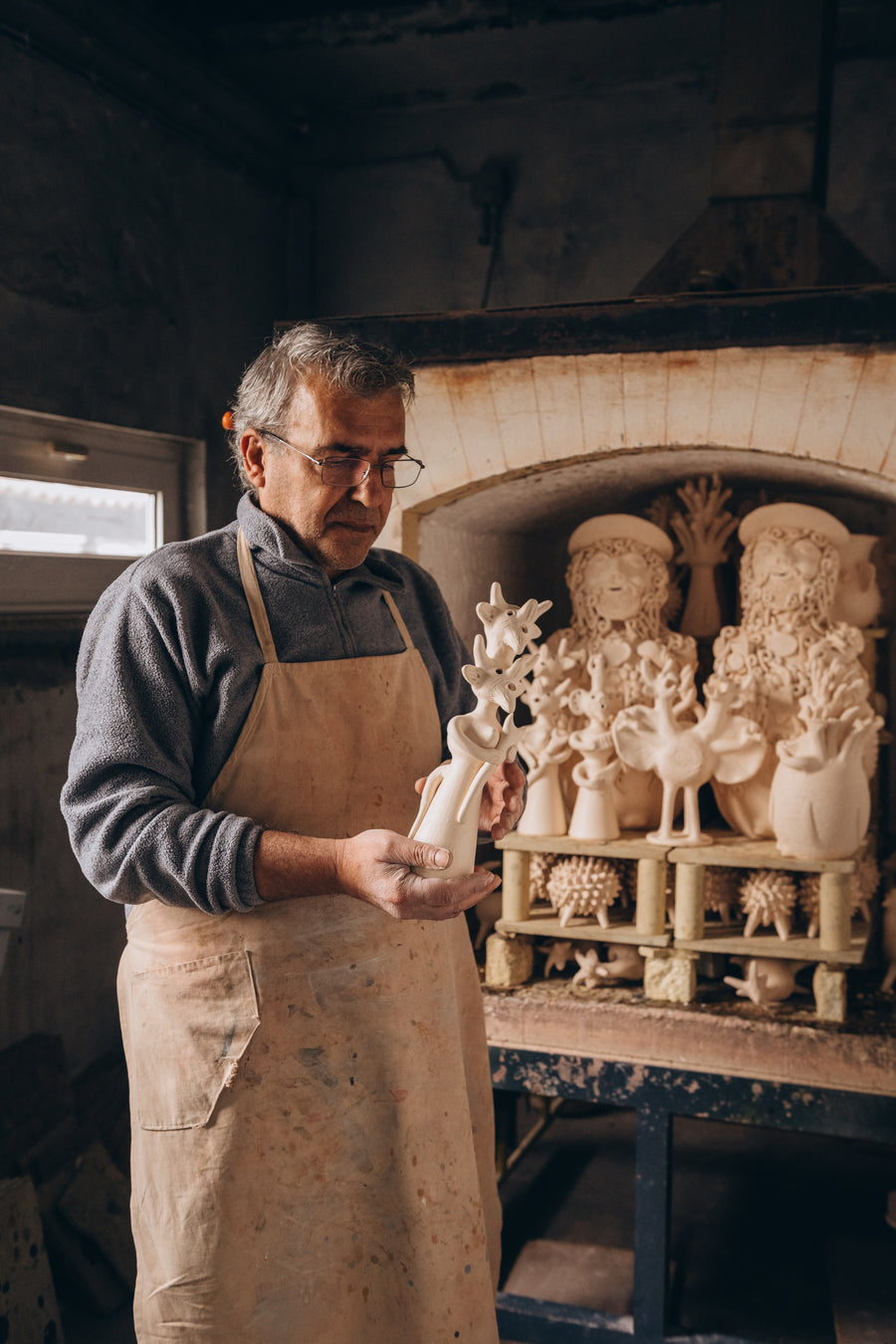
In Aveiro, Diogo Valente builds string instruments by hand. He learned from master José Gonçalves, and in 2023 he was named an Honorary Member by the Museu do Cavaquinho. His Viola Campaniça takes about six weeks to finish. His is not an Alentejo workshop, and I want to be clear about that.
Is traditional salt still made on the Tagus?
Yes, but only just. The Salinas do Samouco, in Alcochete, once had 56 salt pans over 360 hectares. Today only one is still working, the Marinha do Canto, which the Salinas do Samouco themselves describe as the only active salt pan on the Tagus, with a tradition documented since the 13th century and a team of five salt workers. The Salinas do Samouco Foundation, created in 2000, preserves this knowledge.
The salt year starts in March, with cleaning the pans and repairing the wooden edges. In June the first harvest comes out, raked into small heaps. The Flor de Sal is the thin layer of crystals that forms on the surface and is gathered by hand. The full story is on the Salinas do Samouco profile, and our glossary explains what flor de sal is.
Is glassblowing still a master's craft?
Blown glass starts with fire, sand and air, and still needs master glassblowers. In Caldas da Rainha, designer Samuel Reis works side by side with a team of these masters and found a way of his own: he cuts tree trunks that are already hollow and uses them as moulds. The glass is blown inside and the wood decides the rest.
He called it the Cerne project, and the work was shown at the Homo Faber exhibition in Venice. The Cerne da Madeira Glass Jug never comes out the same, because no two trunks are alike.
What happened to the cobertor de papa of Maçainhas?
The cobertor de papa is a thick blanket of Churra sheep wool, woven on wooden hand looms and brushed with long strokes for insulation. In Maçainhas, near Guarda, the José Freire factory closed in 2013 and the blanket went extinct.
Céu Reis had worked there for more than two decades and would not let the story end like that. In 2018, with 15 other members, she founded the association O Genuíno Cobertor de Papa, rescued a hand loom about 300 years old and began weaving again with the factory's former artisans. Today she leads the only certified team that still makes the genuine blanket. In 2019, Guarda City Council started the process to add its making to the National Inventory of Intangible Cultural Heritage and to put it forward to UNESCO. At Ra‑Ro we tell Céu's story, but right now I have no cobertor de papa in the shop to show you, and I would rather say so than pretend.
Where are these rare crafts and what makes them unique?
| Craft | Where | Why it is rare | At Ra‑Ro |
|---|---|---|---|
| Esparto work | Paderne, Albufeira (Algarve) | Few artisans still pull esparto in the hills | Barreleira, by Isidoro Ramos |
| Palm weaving (empreita) | Tavira (Algarve) | Made by women aged 70 to 80 | Spiral Basket, by AECT |
| Burel and wool weaving | Manteigas (Serra da Estrela) | Family workshop since 1925, native Bordaleira wool | Manta Pastor, by Ecolã |
| Hand loom and natural dyeing | Campo Benfeito (Serra de Montemuro) | Village cooperative, dyes from local plants | Burel Jacket, by As Capuchinhas |
| Viola campaniça | Lower Alentejo; built in Aveiro | Nearly vanished in the 1980s | Viola Campaniça, by Instrumentos Valente |
| Traditional salt | Samouco, Alcochete (Tagus) | Only active salt pan on the Tagus, five salt workers | Flor de Sal, by Salinas do Samouco |
| Glass blown in wooden moulds | Caldas da Rainha | Hollow trunk moulds, every piece differs | Cerne Jug, by Samuel Reis |
| Cobertor de papa | Maçainhas, Guarda | Only certified team, loom about 300 years old | Story of O Genuíno Cobertor de Papa |
How can you tell a piece made by a master artisan?
A master's piece has a name, a place and the marks of the hand that made it. Before buying, look for these signs:
- Ask who made it and where. An esparto basket from Paderne and a palm basket from Tavira may look like cousins, but they are different crafts.
- Be wary of identical pieces with no name, sold only as "typical" or "traditional".
- Buy from someone who knows the artisan: at the workshop, at a fair or in a shop that names the maker.
There are other masters too, such as coppersmith Nuno Palma in Loulé. At Ra‑Ro, every piece carries the name of the person who made it, and the Ra‑Ro Index tells you how rare it is.
Frequently asked questions
What are the rarest crafts in Portugal?
There is no single official list. Among the most fragile traditional Portuguese crafts are Algarve esparto work, palm weaving, Serra da Estrela burel, building the viola campaniça, traditional Tagus salt and the cobertor de papa of Maçainhas.
Why are there fewer and fewer master artisans?
Because many crafts stopped providing a living. Where the knowledge survives, it is almost always because someone decided to come back, like Isidoro Ramos with esparto or Céu Reis with the cobertor de papa.
What is the difference between esparto and palm?
They are different plants. Esparto is pulled up in the inland hills of the Algarve and the Alentejo and dried in the sun until golden. Dwarf palm provides the strips braided in empreita.
How many salt workers work at the Salinas do Samouco?
According to the Salinas do Samouco themselves, the Marinha do Canto, the only active salt pan on the Tagus, is worked by a team of five salt workers.
Is the cobertor de papa intangible cultural heritage?
In 2019, Guarda City Council started the process to add the making of the cobertor de papa to Portugal's National Inventory of Intangible Cultural Heritage and to put it forward to UNESCO.
How do I know how rare a piece is at Ra‑Ro?
Every piece has a level on the Ra‑Ro Index, a 1 to 5 scale: Uncommon, Scarce, Rare, Very Rare and Unique. The level appears on each piece, next to the name of its maker.