Cart
0
Burnt wood: what shou sugi ban is, why fire protects wood and how to care for it
What burnt wood and shou sugi ban are, why fire protects wood, how to care for a piece, and the story of Vago, by Luca D'Ortenzi, made from the wood the 2022 fire left on the Serra da Estrela.

In this article
 By Tiago Reis, co-founder of Ra-Ro · View profile
About a 4 minute read

There is a line in the descriptions of Vago's pieces that stuck with me: wildfires leave nothing but a trail of destruction, and yet the story does not end there. I am always wary of pretty stories about tragedies. This one is different, because it does not try to make the fire beautiful. It takes what the fire left and works from there. But before getting to Vago, it is worth understanding what burnt wood is, because there is a centuries-old technique behind the idea.
Burnt wood, or charred wood, is wood whose surface has been exposed to fire until a thin layer of charcoal forms. The best-known technique is Japanese: it is called yakisugi and became known in the West as shou sugi ban. The charred layer protects the wood from water, insects and rot and leaves the grain in relief, in a deep black. In Portugal, on the Serra da Estrela in the Beira Alta, the self-taught woodcarver Luca D'Ortenzi makes bowls, vases and sculptures with Vago from another kind of burnt wood: the wood the August 2022 fire left on the slopes.
What is shou sugi ban (yakisugi)?
In Japan, yakisugi is a traditional way of protecting wooden boards, especially on house façades. Yaki means to burn and sugi is Japanese cedar, the traditional wood. The surface is burnt until charred, cooled in the air or with water and, depending on the finish, left whole, brushed or oiled. Shou sugi ban is the name used mainly outside Japan. Some façades treated this way are centuries old, and today the technique turns up in cladding, furniture and objects, with woods other than cedar.
I like the logic of it, which at first sounds like a contradiction: protecting wood with the very thing that destroys it. The charcoal layer repels moisture, so the wood absorbs less water and moves less. The fire eats away the softest part of the surface, the part insects and fungi prefer. And an already charred surface is harder to set alight. Then there is the beauty. Fire burns the soft parts of each growth ring faster, so the grain stands out. Left whole, the layer is a matt, scaly black; brushed, the loose charcoal comes away and the pattern of the wood appears with a surprising force. A natural oil at the end fixes the charcoal and deepens the tone.
Vago and the wood the fire left on the Serra da Estrela
On 6 August 2022 a fire broke out on the Serra da Estrela that burnt around 24,000 hectares across six municipalities, including Manteigas, Covilhã, Seia and Gouveia. It was the largest in decades on that mountain and left whole slopes of burnt wood.
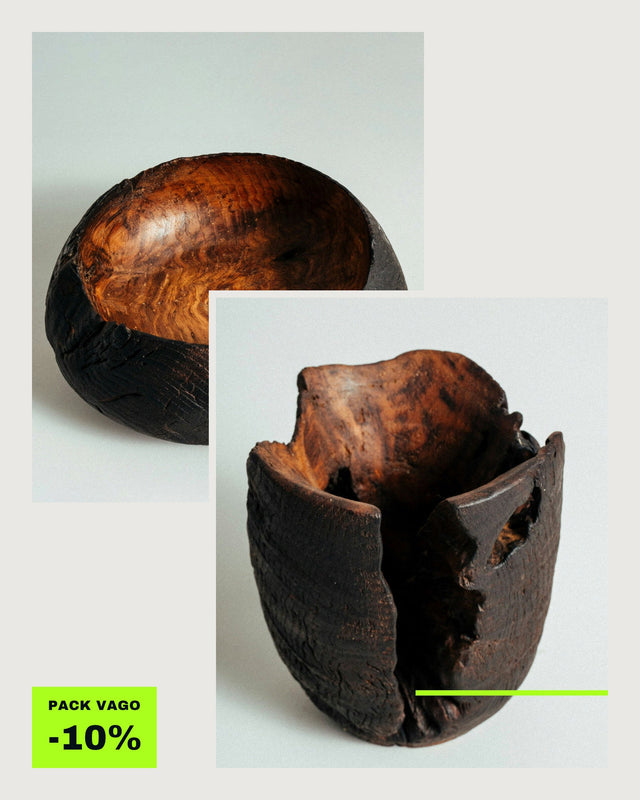
Luca D'Ortenzi went to fetch that wood. He is a self-taught woodcarver from the Serra da Estrela, and it was his urge to experiment and express himself through nature that made him see material there, not just remains. The difference from shou sugi ban matters here, and it is what makes these pieces so strong: the black does not come from a controlled flame in the workshop, it comes from the fire that swept the mountain. In the Cracked Bowl and the Cracked Vase, the cracks and the black were kept on purpose, as a memory of what the mountain went through. I genuinely admire that. It would be easier to sand everything until the wood looked new. Luca chose to hide nothing.
These are one-off pieces, one of each, and each keeps the marks of the tree it came from. The Cosmic Egg shows another side of the same Vago work, more sculpture than everyday object. We tell the story of one of these pieces in The bowl born of fire.
How to care for a burnt wood piece
It is simpler than it looks. Dust it with a soft dry cloth or a gentle brush; in the first weeks the surface may shed a little charcoal, and that is normal. Do not soak it or put it in the dishwasher; if it gets wet, dry it straight away. Now and then, a thin coat of natural oil, wiping off the excess with a cloth, revives the black and fixes the charcoal. Keep it away from radiators and fireplaces, which dry the wood and can open new cracks. And with Vago's pieces, do not try to close the cracks that are already there. They are part of the design and of the story.
If you want both cracked pieces together, the Vago Pack: Burnt Wood brings the Bowl and the Vase together. To get to know the region this wood comes from, read Beira Alta: from the Serra da Estrela to the cobertor de papa or see our Serra da Estrela page. And if you have questions about a specific piece, get in touch.
Frequently asked questions
What is burnt wood?
Wood whose surface has been charred by fire, on purpose or by a wildfire. The charcoal protects it from moisture, insects and rot and brings out the grain.
What does shou sugi ban mean?
It is the name used in the West for yakisugi, the Japanese technique of charring Japanese cedar boards to protect them. Yaki means to burn and sugi is cedar.
Does burnt wood rub off charcoal?
It may shed a little in the first weeks, especially if the layer was not brushed. A thin coat of natural oil helps fix it.
How do you clean charred wood?
With a dry cloth or a soft brush. It should not be soaked or put in the dishwasher, and if it gets wet it should be dried straight away.
Where does the wood in Vago's pieces come from?
From the Serra da Estrela slopes hit by the August 2022 wildfire, gathered by woodcarver Luca D'Ortenzi.
Are the cracks in Vago's pieces defects?
No. They were kept on purpose, as a memory of the fire, and are part of the design of each one-off piece.

 -10%Rare Combinations
 November Selection