Cart
0
Empreita, palm and esparto: what they are and how they differ
Empreita is the braid made from dwarf palm leaves, sewn into baskets, bags and hats. Esparto is a tougher grass, used for rugs, heavy baskets and rope.

In this article
 By Tiago Reis, co-founder of Ra-Ro · View profile
About a 5 minute read

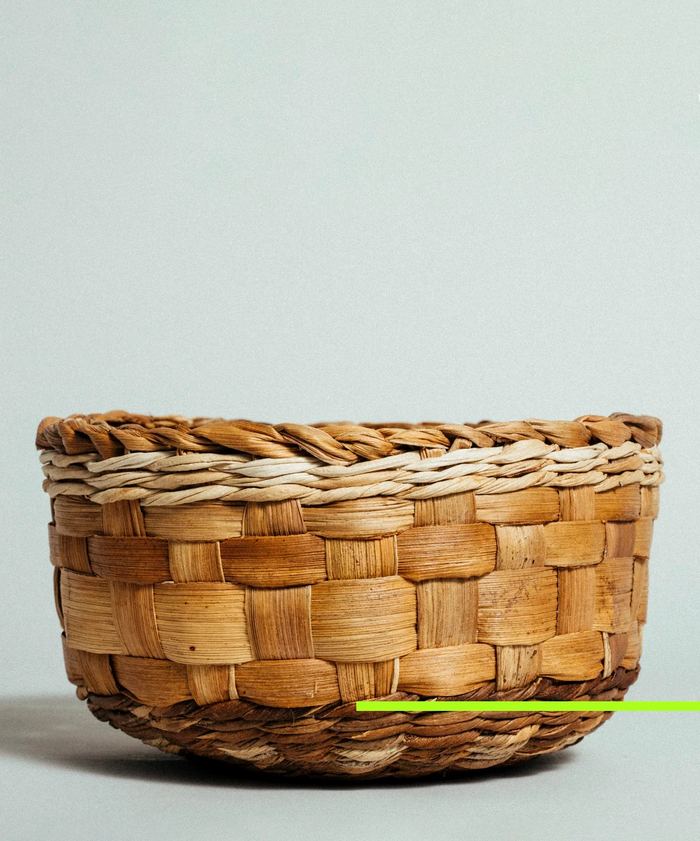
Empreita is the technique of braiding thin strips of palm leaf, from the dwarf fan palm (Chamaerops humilis), into a long band that is then sewn in a spiral to make baskets, carrycots, mats, hats and fans. It is mainly a craft of the Algarve. Esparto is a different plant and a different craft: a tough grass (in the Algarve, Stipa tenacissima from the Barrocal) that makes stiffer, heavier pieces such as rugs, field baskets and rope. They can look alike at first, but the plant, the texture and the uses are not the same.
Empreita, palm and esparto in short
- Empreita: the palm braid and, by extension, the craft of making and sewing it.
- Palm: the leaf of the dwarf fan palm, known in Portugal as palmeira-anã or palmeira-das-vassouras, the only palm native to mainland Europe.
- Esparto: a grass with thin, very strong leaves; in the Algarve the species used is Stipa tenacissima, which grows in the Barrocal.
- Where: mostly in the Algarve, from the hills to the Lower Guadiana.
- Main difference: palm gives light, smooth pieces; esparto gives rougher, harder and heavier ones.
- At Ra-Ro: palm by the senior craftswomen of Tavira and esparto by Isidoro Ramos.
What empreita is
In the Algarve, empreita is the name for the braid made from strips of palm leaf and, by extension, for the whole craft. The dwarf fan palm is a low shrub that grows wild on the dry hills of the south. Its fan shaped leaves are stiff, but once dried and moistened they bend without breaking. For generations they were used for containers to store and carry figs, almonds and carob, for the gorpelhas slung over a donkey's back and for the capacheiras used to sift flour. Later came mats, hats, fans, fruit bowls and bottle covers. In Castro Marim, palm baskets held the salt from the salt pans. See also the glossary entries for empreita and palm.
Where empreita is made
The heart of empreita is the Algarve: the hills and the barrocal, inland Loulé, São Brás de Alportel and Tavira, and the Lower Guadiana. The Saber Fazer programme, which maps Portuguese crafts, lists empreita artisans and workshops in municipalities such as Monchique, Portimão, Silves, Loulé, São Brás de Alportel, Castro Marim and Vila Real de Santo António, and also outside the Algarve, for example in Santiago do Cacém. To get to know the region and its crafts, see our Algarve page.
How empreita is made
- Gathering: the palm leaves are cut in the field.
- Drying: they are washed, dried in the sun and sorted by thickness.
- Strips: each leaf is split into thin strips, which are dampened to keep them supple. Some are dyed to create patterns.
- Braiding: the strips are braided into a long band, the empreita.
- Sewing: the band is coiled and sewn to itself with a needle and a thin cord of twisted palm, the baracinha, until it takes the shape of the piece.
It was mostly women's work, done on winter evenings when there was nothing to do in the fields.
What esparto is
Esparto is the name of Mediterranean grasses with long, thin and very tough leaves. The one with the strongest fibre is Stipa tenacissima (also classified as Macrochloa tenacissima), which grows in Portugal, Spain and North Africa; another plant, Lygeum spartum, is also called esparto. In the Algarve, the esparto used is Stipa tenacissima, which grows in the Barrocal. Preparing it is hard work: the leaves are pulled up and dried in the sun and, for many pieces, soaked for several days before they can be worked. Around Alte it was used for rugs, baskets and carrycots known for lasting a lifetime. More in the glossary: esparto.
Palm and esparto: the difference
- Plant: palm is the leaf of a palm tree; esparto is a grass.
- Preparation: palm is dried and split into strips; esparto is dried and often soaked for days.
- Texture: palm is smooth, pale and light; esparto is fibrous, rough and stiff.
- Technique: palm is braided into bands that are then sewn; esparto is braided or twisted into thicker cords.
- Uses: palm for carrycots, hats, fans, mats and bags; esparto for rugs, load baskets, rope and pieces that carry weight.
- Regions: in Portugal, both mainly in the Algarve: palm from the hills to the Guadiana, esparto in the Barrocal, with Alte as a reference.
The craft today
Both crafts lost their place when plastic reached the countryside. Empreita is still alive, handed down in families and taught in workshops, and some artisans are taking it into bags and new designs, although it is hard to make a living from it alone. Esparto came closer to disappearing: in Querença, near Loulé, the QRER cooperative has run courses to teach new hands how to gather, treat and work the plant.
Where to buy palm and esparto: the pieces at Ra-Ro
In Tavira, the senior craftswomen of AECT still weave palm as it was done when farmers made their own tools. From them come the Handmade Bag (€42.20), which takes the tradition out into the street, and the Tavira Palm Pack (€75.96), with the bag and the lidded basket, 10% cheaper than buying both pieces separately. The story is told in The Tavira palm bag.
Isidoro Ramos works esparto the way his grandmother and mother taught him. The Barreleira (€246.20) is a basket for dirty laundry before it went to the lye wash, and its story is in Isidoro Ramos's barreleira. The Caracoleira (€66.20) is the small basket carried on the shoulder to gather snails. The Donkey Head (€26.50) pays tribute to the animal that worked alongside farmers and is now almost extinct in the Algarve; read more in The esparto Donkey Head. The Esparto Pack (€78.03) brings together the caracoleira and the donkey head bottle topper.
Frequently asked questions
What is empreita?
It is the Algarve technique of braiding strips of dwarf palm leaf into a long band, which is then sewn in a spiral to make baskets, carrycots, mats, hats and fans.
Which plant is Algarve palm?
The dwarf fan palm (Chamaerops humilis), a low shrub that grows wild in southern Portugal and is the only palm native to mainland Europe.
What is esparto?
A grass with thin, very strong leaves. In the Algarve the species worked is Stipa tenacissima, which grows in the Barrocal and is used for rugs, baskets, carrycots and rope.
What is the difference between palm and esparto?
Palm is the leaf of a palm tree and gives light, smooth pieces that are braided and sewn. Esparto is a rougher, more fibrous grass that gives hard, heavy pieces.
Where is empreita made in Portugal?
Mainly in the Algarve, in the hills, the barrocal and the Lower Guadiana, with workshops in municipalities such as Loulé, São Brás de Alportel, Tavira and Castro Marim.
Where can I buy palm and esparto crafts?
At Ra-Ro, with palm pieces by the senior craftswomen of Tavira and esparto baskets by Isidoro Ramos, such as the barreleira and the caracoleira.
 Autumn
 -10%Packs
 Regions