

Cart
0

 By Tiago Reis, co-founder of Ra-Ro · View profile
About 3 min read

Fifty years ago in Tavira, it was still common for farmers to make their own baskets. Not the spade or the sickle, those they bought. But what use are tools if there's nothing to carry the harvest in? Potatoes, carob pods. It all fitted in a homemade palm leaf basket.
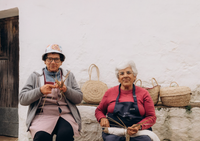
The Handmade Bag is a palm leaf bag woven by hand in Tavira, in the Algarve, by women aged between 70 and 80, through AECT (Associação Em Contacto Tavira), from the same plant that grows on the common land where they spent their youth.
Who makes this bag?
AECT is an association that promotes active ageing and fights isolation and exclusion among older people. It was through them that we met these artisans and three pieces that descend from the tradition of palm leaf baskets. This bag is one of them.
And there was one thing we found hard to believe: as well as weaving, some of these artisans still work in the fields every day. It's hard not to be moved. In their faces, their hands and their stories there's a tapestry of time and strength that no text can sum up properly.

What is palma and why does it matter?
Palma is the leaf of a palm that grows on the common land of the Algarve and that, dried and plaited, was used for generations to make baskets for the fields. In this bag it's woven by hand, and each one keeps the small differences of whoever made it.
I really love this bag for a simple reason. It was born from a need, carrying the harvest home, and it has come down to us without losing its truth. It doesn't need to be sold as a trend. It's a good bag, made by people who know how, with a plant that was always there.
From harvest to city
Potatoes and carob pods. That's what went into the palm baskets of Tavira. Today it holds a wallet, a book, the shopping from the market. The shape has adapted, the technique hasn't. The artisans still weave the same plant, from the same land, with the same hands that once gathered it for work.
There's something very beautiful in thinking that this bag will stroll around the city and that it was made by someone who, that very same day, may have been out in the fields. It's a direct link between two worlds we usually imagine as separate.
AECT did something clever: it realised that these women's know-how was a treasure and that sharing it was also a way of fighting isolation. The bag is the visible result. The invisible part is the conversations, the company and the importance of carrying on making.
Who is it for?
For people who love objects with a true story behind them. It works for the market, for the beach, for every day. And every time it leaves the house, it takes with it a bit of Tavira and of the women who keep on weaving it.

Frequently asked questions
Who makes the Handmade Bag?
Women aged between 70 and 80, in Tavira, through AECT (Associação Em Contacto Tavira). Some still work in the fields every day.
What is the bag made of?
Palma, the leaf of a palm that grows on the common land of the Algarve, woven by hand.
Where does this tradition come from?
From the palm leaf baskets that Tavira's farmers made to gather potatoes and carob pods, a practice still common fifty years ago.
What is AECT?
It's the Associação Em Contacto Tavira, which promotes active ageing and fights isolation and exclusion among older people.


