

Cart
0

 By Sérgio Carvalho, co-founder of Ra-Ro · View profile
About 3 min read

From Hi5 to Messenger, from Facebook to WhatsApp. We spent twenty years inventing ways to be closer to one another and, somewhere along the way, we lost the ones we already had. One of them was waiting. I thought about that the first time I saw a barreleira.
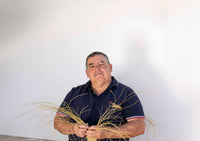
The Barreleira is a laundry basket in esparto made by hand by Isidoro Ramos, a craftsman from Paderne, in the Algarve, with empreita, the technique of plaiting and stitching esparto grass that he learned as a child from his grandmother and his mother. It was used to keep dirty laundry while it waited for the barrela.
The barrela was how laundry was whitened in the old days. Boiling water, soap and sifted wood ash, in an iron or wooden tub. Clothes were washed in the river or at home, on washboards and, later, in stone tanks. The barreleira sat in the middle of all this. The basket where the laundry waited its turn.

The gesture
Esparto is a native grass that Isidoro Ramos watches grow in the fields and hills of the Algarve. He pulls it up between July and September, leaves it in the sun until it turns golden and then soaks it to soften it. Only then does he plait it. Empreita is a braid of esparto that is coiled and stitched onto itself, with a thick needle and jute or sisal cord, until it takes on the volume of a piece.
To make the barreleira, Isidoro Ramos coils the braids for the base and then works upwards. Slowly. With pressure and precision until he reaches the top. The lid takes a narrower braid. None of this can be rushed.

Esparto, empreita, barrela: three words worth keeping
Esparto is the fibre. Empreita is the braid made from it. Barrela is the process of whitening laundry with ash. Three words from the same world, which today you hear almost only in the hills of the Algarve and in a handful of homes where people still work this way. Isidoro Ramos uses all three every day. They're rarely said, but they count for a lot.
The barreleira has a lid, and that says a lot about its purpose. The laundry was kept, protected, waiting for wash day. A basket with a lid in a house where everything had its time. Today, the same lid hides yesterday's clothes in a modern bathroom. The function has barely changed. We're the ones who changed.
Some people ask why a basket like this costs what it costs. The answer is in the calendar: esparto can only be pulled up between July and September, it dries in the sun, it's soaked, plaited and stitched round by round. Each barreleira takes weeks. And it carries the memory of two women who taught a boy from Paderne not to let this die.
What the machine took away
The washing machine solved a real problem, and a good thing it did. Technology is a means. But what was lost wasn't clean laundry. It was the time of the barrela and what happened during it: the chat by the washing tank, the neighbour who helped wring things out, the household calendar organised around a wash day.
The barreleira holds all of that without saying so. It holds the esparto of the Algarve hills, the hands that pulled it up and the technique Isidoro Ramos's grandmother and mother taught him. That's why I treat it as an archive more than a basket.
Do we need a barreleira in a house with a washing machine? Maybe not. Or maybe we need exactly that, to remind us that there was a time when waiting was also a way of being together. That's the question we might ask ourselves.
From Hi5 to WhatsApp, we keep inventing ways to be close. The barreleira is one of the old ones. My advice stands: use it for the laundry, and let it remind you of the rest.
Frequently asked questions
What is a barreleira?
It's a basket where dirty laundry was kept while it waited for the barrela, the old way of whitening clothes with boiling water, soap and ash. Isidoro Ramos makes his by hand in esparto.
Who makes the Ra-Ro Barreleira?
Isidoro Ramos, a craftsman from Paderne, in the Algarve. He learned esparto work as a child from his grandmother and his mother.
What is empreita?
It's a braid of esparto coiled and stitched onto itself, with a thick needle and jute or sisal cord, until it forms the piece. It's the traditional technique of Algarve esparto basketry.
How is the esparto prepared?
It's pulled up between July and September, dried in the sun until golden and then soaked so it becomes soft enough to plait.
What can I use the barreleira for today?
As a laundry basket, with a lid, or as a storage and decorative piece. It's the same function as ever, in a home of today.


