Cart
0
Devils, Sarroncos and Mafarricos: the dark side of Portuguese figurado
From the Barcelos Devil to the Sarronco and the Mafarrico: who Rosa Ramalho was, why figurado de Barcelos is full of devils, the Rooster legend and how to spot an author piece.

In this article
 By Tiago Reis, Ra-Ro co-founder · View profile
About a 6 minute read

I will admit it: it fascinates me that such a devout people spent generations shaping the Devil with their own hands. In Barcelos, clay is not only for saints and roosters. It is also for horns, stuck out tongues and bulging eyes, and it is hard to look at these figures without smiling and feeling, at the same time, a small shiver.
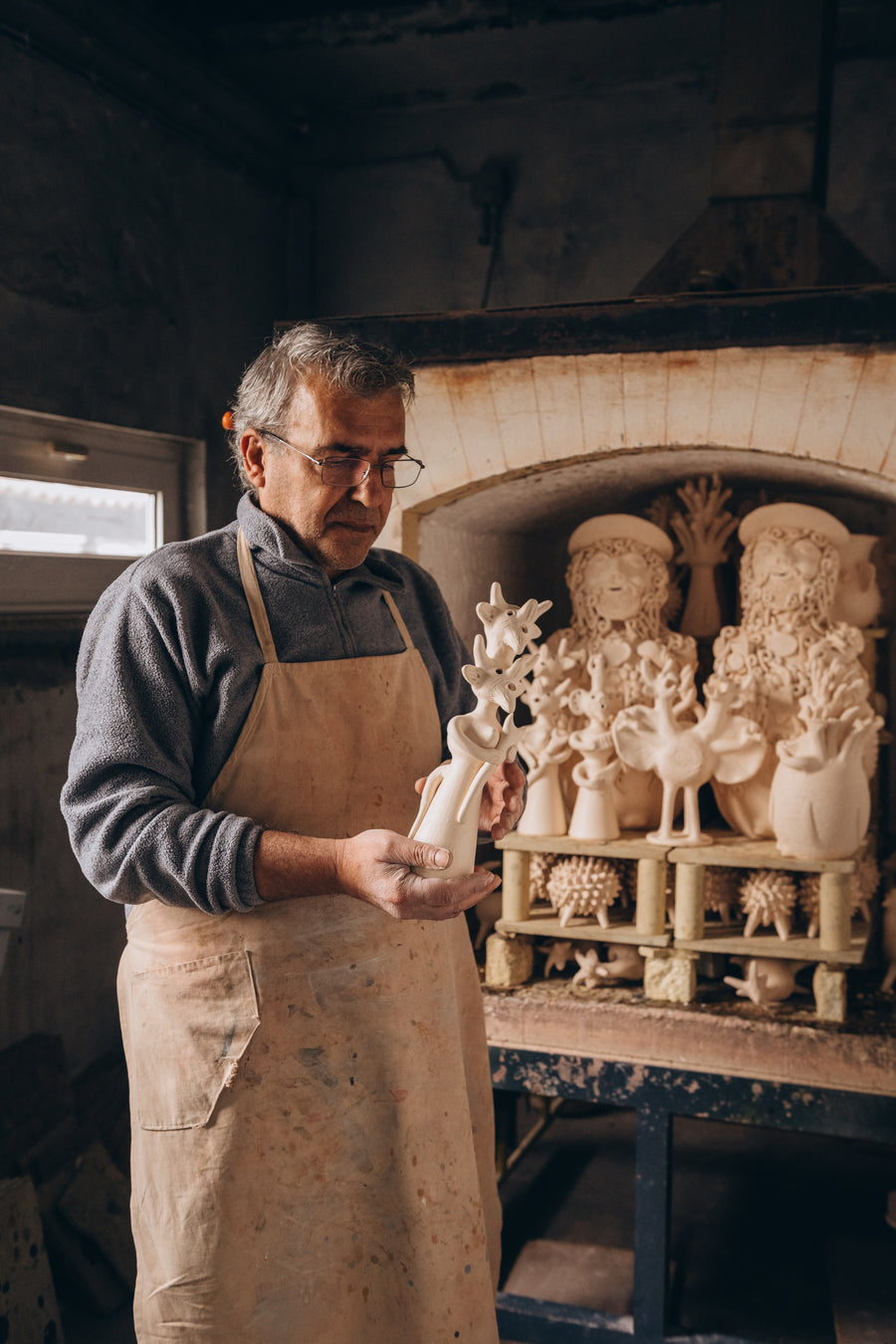
Figurado de Barcelos is the art of modelling clay (ceramic paste) figures in the parishes of Galegos Santa Maria and Galegos São Martinho, in the municipality of Barcelos, in Portugal's Minho region. It began alongside pottery, became famous through the potter Rosa Ramalho and, since July 2026, is listed in Portugal's National Inventory of Intangible Cultural Heritage.
What is figurado de Barcelos?
Figurado de Barcelos is a handmade tradition of figures in ceramic paste, made mainly in Galegos, in the municipality of Barcelos. It started as a sideline of pottery: potters used small leftover portions of clay to make little people and animals, often with a whistle in the base, which were toys. Over time, those figures gained signatures and the names of their makers.
On 10 July 2026, figurado de Barcelos was entered in the National Inventory of Intangible Cultural Heritage. The community described in the process has around 100 active people, including about 50 artisans, and production runs all year round. I really like this: it is not an art frozen in a museum, it is a living workshop art that seeks a balance between tradition and innovation.
Who was Rosa Ramalho?
Rosa Ramalho was the potter who made figurado de Barcelos known in Portugal and abroad. She was born Rosa Barbosa Lopes on 14 August 1888, in São Martinho de Galegos, and died in 1977, aged 89. She learned the craft as a child, married a miller and stepped away from clay to raise her family.
Only after she was widowed, in 1956, at the age of 68, did she return to clay seriously. A whole world came out of it: everyday scenes, musicians, Christs, saints and angels, but also what she called the "world of monsters", with devils, werewolves, sarroncos and hybrid beasts. She signed with two letters, RR, in a monogram designed by the painter Jaime Isidoro, and she received the medal "As Artes ao Serviço da Nação" and the rank of Dame of the Military Order of Saint James of the Sword.
Her granddaughter, Júlia Ramalho, carried that imagination forward, Medusas and deadly sins included. Her great-grandson, António Ramalho, Júlia's son, is the one who models the Devil, the Sarronco, the Medusa and the Parideira we have at Ra-Ro.
Why are there so many devils in figurado de Barcelos?
There are so many devils because, in the folk imagination of the Minho, the Devil is the figure that frightens and seduces at the same time. Rosa Ramalho took them from local superstitions and mountain stories, and she wondered whether there were still "those beasts up in the hills". In her pieces, devils often stand side by side with saints and angels, in a struggle the clay always leaves unresolved.
The theme is so strong that the Museu de Olaria (Pottery Museum) in Barcelos devoted an exhibition to it in 2025, "Uma coleção dos Diabos": around 300 pieces by more than 100 artists, gathered by the collector José Santos Silva. The turning point of that collection, he said, was a devil by Rosa Ramalho.
António Ramalho's Barcelos Devil is a direct homage to his great-grandmother. It is hard to write this sentence without a lump in my throat: four generations later, the same devil is still being born inside the same family.
What is the Sarronco?
The Sarronco is what people in Barcelos call the bogeyman (Papão), the creature adults used to frighten children. António Ramalho grew up hearing his mother and the elders call on the Sarronco, and he put that voice into clay. Sarroncos were already part of Rosa Ramalho's bestiary, next to devils and ferocious beasts.
I love the Sarronco because it is a homely fear, almost tender. It is not the Devil of sermons, it is the monster at the end of the corridor, the one that only exists while the light is off.

What does mafarrico mean?
Mafarrico is an informal Portuguese word for devil. The Priberam dictionary also records the sense of an unruly, devilish person and of a naughty child, gives the variant manfarrico and considers the origin of the word obscure.
Our Mafarrico does not come from Barcelos, and I want to say this clearly. It is made by Andreia Pinho in her workshop in Leiria, with wild clay she collects by hand in different parts of Portugal. It is Portuguese folk figurado, from the same family of mischievous devils, but it is not figurado de Barcelos.

What is the legend of the Rooster of Barcelos?
The legend says a Galician pilgrim on his way to Santiago de Compostela was accused of a crime in Barcelos and sentenced to hang. Before the judge, who was at dinner, he pointed to a roasted rooster and swore it would crow when he was hanged, as proof of his innocence. The rooster stood up and crowed, and the pilgrim was found alive, saved by a badly tied knot.
Years later, he is said to have returned to raise the Cruzeiro do Senhor do Galo, a 17th century monument now kept in the Archaeological Museum of Barcelos. The rooster became one of Portugal's main symbols in the world. At Ra-Ro, the Rooster of Barcelos by Porfírio Mendes is carved in cork and painted in the traditional colours: red crest, hearts, yellow and turquoise. Porfírio lives in Barcelos, works in construction by day and carves cork by night. He also made the Cork Devil, a fiddler devil.

How much does an author devil figure cost?
At Ra-Ro, an author devil costs between €51.20 (in cork, by Porfírio Mendes) and €79.50 (in clay, by António Ramalho), and the Sarronco costs €157.90. The table gathers the figures of this dark side, plus one rooster for relief.
| Figure | Maker | Material | Origin | Price at Ra-Ro |
|---|---|---|---|---|
| Barcelos Devil | António Ramalho | Clay | Barcelos | €79.50 |
| Sarronco (Bogeyman) | António Ramalho | Clay | Barcelos | €157.90 |
| Medusa | António Ramalho | Clay | Barcelos | €53.00 |
| A Parideira (The Birth Giver) | António Ramalho | Clay | Barcelos | €53.00 |
| Mafarrico (Devil) | Andreia Pinho | Wild clay | Leiria | €54.20 |
| Cork Devil (fiddler) | Porfírio Mendes | Cork | Barcelos | €51.20 |
| Rooster of Barcelos | Porfírio Mendes | Painted cork | Barcelos | €60.20 |
How can you tell an author piece from an imitation?
An author piece has a name, a signature and the marks of the hand that made it. Before buying, look for these signs:
- Look for the artisan's signature or mark. Rosa Ramalho marked her pieces with the RR monogram, conceived as a symbol of authenticity.
- Know who made it and where. Figurado de Barcelos comes from Galegos; a devil from Leiria or in cork can be just as authentic, but it is not figurado de Barcelos.
- Accept irregularities. Hand modelling and hand painting leave small differences between pieces.
- Buy from someone who knows the maker: the artisan, the weekly Barcelos market (on Thursdays, at Campo da República) or a shop that names who made the piece.
- Be wary of identical, nameless figures sold only as "typical".
At Ra-Ro, every piece carries the name of its maker, and the Ra-Ro Index tells you how rare it is.
Frequently asked questions
Where can you see figurado de Barcelos in person?
At the Museu de Olaria in Barcelos, which held an exhibition devoted to figurado devils in 2025, and at the weekly Barcelos market, on Thursdays at Campo da República, where you find pottery, roosters and other crafts.
Is figurado de Barcelos officially cultural heritage?
Yes. It was entered on 10 July 2026 in Portugal's National Inventory of Intangible Cultural Heritage. The process identifies the parishes of Galegos Santa Maria and Galegos São Martinho and around 50 active artisans.
Who is António Ramalho?
António Ramalho is a Barcelos clay artist, great-grandson of Rosa Ramalho and son of the potter Júlia Ramalho. His Barcelos Devil is a homage to his great-grandmother, and his Sarronco comes from the bogeyman his family used to scare children.
Is the Ra-Ro Mafarrico figurado de Barcelos?
No. The Mafarrico is by Andreia Pinho, who works in Leiria with wild clay collected by hand in different parts of Portugal. It is Portuguese folk figurado, but it does not belong to the Galegos tradition of Barcelos.
What does the RR mark on Rosa Ramalho's pieces mean?
RR are Rosa Ramalho's initials. The monogram was designed by the painter Jaime Isidoro and began to mark her pieces as a symbol of authenticity, something collectors look for today.
Are cork devils also figurado de Barcelos?
Not strictly, because figurado is made in ceramic paste. Porfírio Mendes's Cork Devil is carved in Barcelos and shares the same imagination, but the material and the technique are different.