Cart
0
Redondo pottery: Xico Tarefa, Zeza and the painted ware born between the wheel and the brush
Xico Tarefa, a master potter from Redondo, has worked clay on the wheel since he was 13; his wife, Zeza, paints the pieces by hand. Tiago Reis writes about Olaria XT, the people behind it and the painted Alentejo ware...

In this article
 By Tiago Reis, co-founder of Ra-Ro · View profile
About a 4 minute read

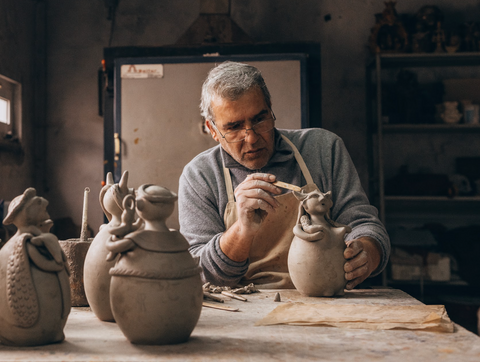
Some nicknames say a lot about a person. Francisco José Rosado's is Tarefa, which means task in Portuguese, and it sounds like work, like a long day, like something that has to get done. I like it. But the nickname is the least interesting part of this story. The part that holds me starts at 13, in front of a potter's wheel, in the Alentejo.
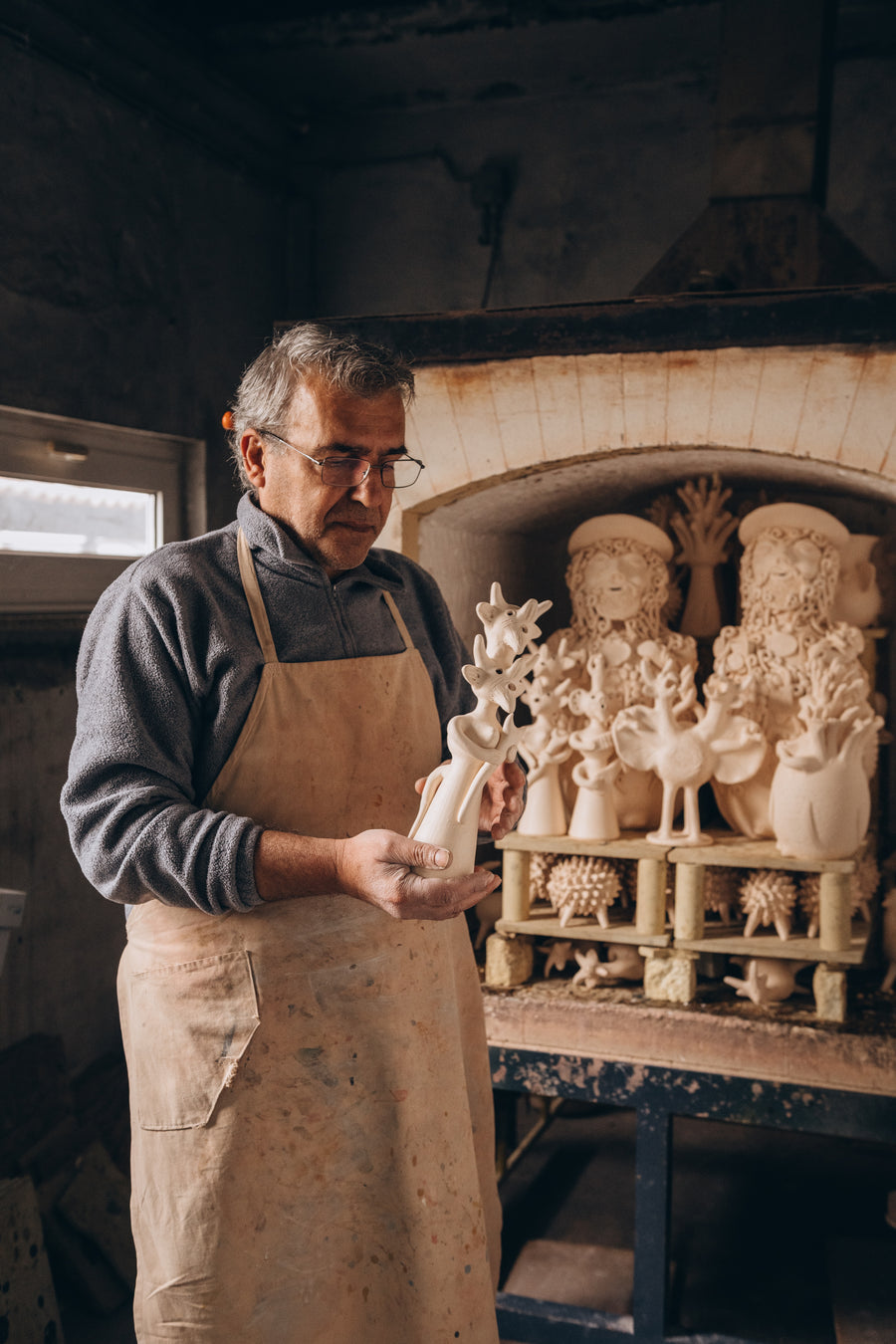
Olaria XT is the traditional pottery workshop of Xico Tarefa, as Francisco José Rosado is known, in Redondo, a municipality in the district of Évora, in the Alentejo. Xico has thrown clay on the wheel since he was 13, and his wife, Zeza, paints the pieces by hand with Alentejo motifs: sunflowers, olives, flowers, an owl. Together they make painted ware for everyday use, such as plates, tureens, olive dishes, cups, jugs and water jars, carrying on the pottery of Redondo and giving it a voice of its own.
Pottery is the craft of shaping clay and firing it to make useful pieces. At its centre is the potter's wheel, a turning disc on which the hands raise a piece from a ball of clay. But the wheel comes later. First you have to know the clay, choose it, understand how it behaves and prepare it. Xico Tarefa learned this from the masters, among them Ezequiel Campainhas, and became a master potter at 16.
Sixteen. It is hard to read that and not think about what it means to be a master of a craft at the age when most of us had no idea what we wanted to do. It is not a biographical detail. It explains everything that follows.
What does Olaria XT make?
Over the decades, Xico Tarefa's wheel has turned out chocolate pots, plates, salad bowls, cantarinhas, alguidares (wide clay basins), barrels, fish platters, pots and frying pans. Kitchen and table ware, made to be used every day. His work stands out for its precise drawing and for an aesthetic closely tied to rural life and Alentejo identity. In 2000 he opened his own workshop, Olaria XT, and that is where he still works. Anyone who read what I wrote about the clay alguidar will understand why this list excites me: these are the pieces that built the Portuguese kitchen, still coming off a wheel.
Zeza and the painting
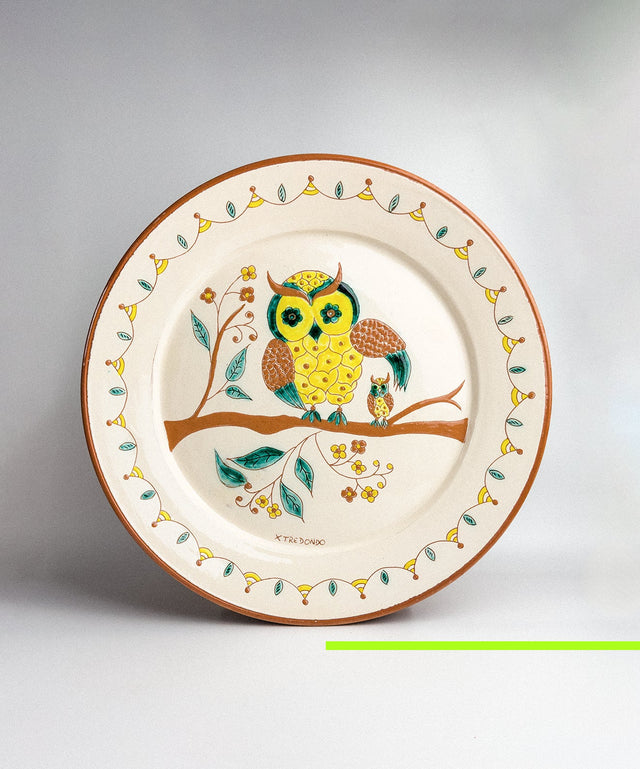
After the wheel comes the brush, and there Zeza is in charge. In the painting of Olaria XT pieces she has the leading role: the traditional Alentejo colours and motifs that make this ware recognisable come from her hands. On the owl plate, a large plate that works on the table or hanging on a wall, there is a painted owl, the bird we link with wisdom. A tureen for Alentejo soups carries sunflowers. And on the moringue, the clay jar that kept water cool on hot days, Zeza painted a face. That part fascinated me. A purely useful object suddenly has someone looking back at us.
I cannot pick a single protagonist in this story, and I do not think it is necessary. The shape is Xico's, the colour is Zeza's, and each piece only exists because the two skills meet. There is something beautiful about a workshop where one person's work carries on in the other's.
And there is something else I admire in Xico Tarefa: just as he learned from masters, he likes to teach. He has taken part in exhibitions, in projects to promote ceramic heritage and in training. In 2024 he led, with Marta Castelo, an artist residency devoted to traditional pottery, putting the wheel and the decorative techniques within reach of those who wanted to learn. A craft only survives if someone passes it on. He does.
Redondo, by the way, has a knack for bringing crafts together. It is also where Zézinha works, painting flowers on wood for four decades, as Sérgio told in the article on Alentejo painted furniture. Flowers on wood, flowers on clay. The same land, another material.
How do you recognise a hand painted, wheel thrown piece? Two pieces of the same model are never exactly alike: height, the curve of the rim and thickness vary a little. In the painting, each brushstroke has a beginning and an end, and the motifs repeat without copying each other. If you want to go further, we listed eight signs of a handmade piece.
Tarefa turns out to be a good nickname for someone who has done the same thing for decades and still does it well. The full story is on the producer page, Olaria XT, and Xico and Zeza's pieces are already in the shop.
Frequently asked questions
Who is Xico Tarefa?
Xico Tarefa is the name by which Francisco José Rosado is known, a master potter from Redondo, in the Alentejo, who has worked clay on the wheel since he was 13 and became a master at 16.
Where is Olaria XT?
In Redondo, a municipality in the district of Évora, in the Alentejo. It is the workshop Xico Tarefa opened in 2000.
Who paints the Olaria XT pieces?
The painting is done by hand by Zeza, Xico Tarefa's wife, with Alentejo motifs such as sunflowers, olives, flowers and owls.
What pieces are made in Redondo pottery?
Everyday kitchen and table ware: plates, tureens, salad bowls, basins, pots, frying pans, small jugs, barrels, cups, jugs and water jars.
How can I recognise hand painted wheel thrown ware?
Pieces of the same model show small differences in shape and thickness, and the painting shows brushstrokes with a beginning and an end, never mechanical repetition.
Where can I buy painted pottery from Redondo?
At Ra-Ro, which has Olaria XT pieces thrown by Xico Tarefa and painted by Zeza, including an owl plate, a tureen and a moringue water jar.


 -10%Rare Combinations
 November Selection