Cart
0
Saint Anthony in cork: the sacred irreverence of Porfírio Mendes
Porfírio Mendes carves Saint Anthony in Portuguese cork with humour, warm colours and an irreverent expression. Discover the story of this rare piece.

In this article
 By Tiago Reis, co-founder of Ra-Ro · View profile
About 3 min read

There are saints you pray to in silence and saints you celebrate in the street. Saint Anthony is one of the latter. And it was that festive soul that Porfírio Mendes decided to carve in cork. It's hard to look at this piece without smiling.
Porfírio Mendes's Saint Anthony is a one-of-a-kind sculpture, carved by hand in cork, that reinterprets one of Lisbon's best-loved figures with humour, warm colours and a deliberately exaggerated expression.
Who was Saint Anthony?
He was born in Lisbon at the end of the 12th century as Fernando de Bulhões. He became a Franciscan friar, a traveller and a thinker, and was one of the great preachers of his time. He died in Padua and was canonised just eleven months later. For us, he's from Lisbon. For so many others, from Padua.
They call him the Matchmaker Saint. Because of the legends, but also because in his lifetime he defended love over the dowry. Maybe that's why he still feels so close. In June he always comes back, in the streets, in the songs, in impromptu get-togethers, in shared affection.

Why does cork make sense?
Cork is the bark of the cork oak, light and deeply Portuguese. Choosing this material for a saint brings him down to earth, close to us. And Porfírio Mendes goes further: he gives him warm, deliberate colours, an expression that escapes solemnity, and lets the sacred take on a complicity few materials would allow.
I really love this. There's irreverence, even a rebellious streak, but never disrespect. It's a way of loving the saint that I know well: with affection and with humour.
Who is Porfírio Mendes?
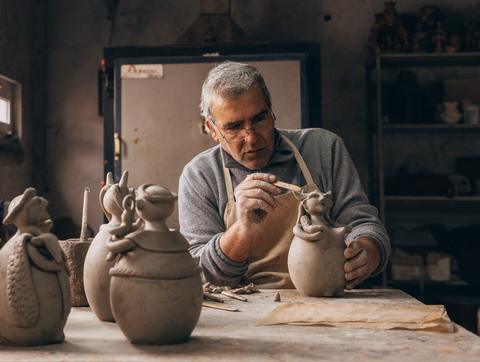
He is a craftsman with a rare gift (in Portuguese, a dote, the same word as dowry): the singular reinterpretation of classic figures, with humour, expressiveness and character. The word could not be more fitting for someone who carves the Matchmaker Saint. Each piece is carved by hand, and no two are alike.

Between the sacred and the popular, this Saint Anthony is memory, affection and imagination. And it's also proof that you can take tradition seriously without taking it too seriously.


Frequently asked questions
What is this piece?
A sculpture of Saint Anthony hand-carved in cork, with a good-humoured tone that moves away from traditional religious solemnity.
Who makes this piece and where?
The artisan Porfírio Mendes, in Barcelos. Each piece is carved by hand and is unique.
What technique and materials are used?
It is hand-carved in cork, using a knife, sandpaper and glue, and is then painted in warm earth tones.
Why is it rare?
It is a handcrafted piece made by hand, so each example is unique; its making takes more than three weeks.
Why cork?
Porfírio Mendes chose cork, the most Portuguese of all materials, to state that the sacred can be earthly and rooted in its own heritage.
How to care for the sculpture?
It is intended for decorative purposes; handle it with care, keep it in a protected place and dust it with a dry cotton cloth or soft brush.


 Autumn
 -10%Packs
 Regions