Cart
0
Bitter honey from the strawberry tree: what it is and how to use it
Portuguese bitter honey is strawberry tree honey, made in autumn and winter in the southern hills. I explain why it is bitter and rare, where it comes from, how it tastes and how to use it.

In this article
 By Tiago Reis, co-founder of Ra‑Ro · View profile
About an 8 minute read

There is a honey that is only made once almost every other bloom is over. The first autumn rains arrive, the days get shorter and, in the southern hills of Portugal, the strawberry tree opens its flowers next to its red fruit. That is when, in the cold and damp, some bees keep working. The result is bitter honey, and I will admit it is one of the products that surprised me most since we started Ra‑Ro.
Bitter honey, mel amargo in Portuguese, is strawberry tree honey (Arbutus unedo), also called mel de medronho: bees make it from the nectar of strawberry tree flowers, which usually open between October and January. It is dark, crystallises quickly, has a bitter finish that recalls coffee, and it is rare because it is born in the cold season. In Portugal it is linked above all to the hills of the Algarve and the Alentejo.
What is bitter honey?
Bitter honey is the everyday Portuguese name for strawberry tree honey. People also call it mel de medronho, because the tree's fruit is the medronho, the same fruit that gives us medronho brandy. It is not burnt honey and it is not a blend: the bitterness comes from the flower itself.
It is a niche honey, meant for people who enjoy intense flavours. Portugal and Sardinia, in Italy, are two of the places where most of it is made; Sardinians call it miele di corbezzolo. Our glossary entry on bitter honey fits it into a few lines. Here I want to go further: where it comes from, why it is so hard to find and what to do with it at the table.
Why is strawberry tree honey bitter?
Strawberry tree honey is bitter because of the strawberry tree's nectar, whose composition differs from that of spring flowers. Researchers who studied this honey found compounds in it that work like a fingerprint: homogentisic acid, two abscisic acids and a new molecule they named unedone, after the tree's scientific name. These markers are used to confirm the honey's floral origin in the laboratory, as described in a study published in the Journal of Agricultural and Food Chemistry.
I will not pretend I have mastered the chemistry. What I know is what you feel in your mouth: a sweet first touch and, right after, a lingering bitterness. The first time, I pulled a face. The second time, I was the one going looking for it.
When is strawberry tree honey made?
Strawberry tree honey is made in autumn and winter, while the strawberry tree is in flower. An article by João Martins and Jorge Canhoto in the Portuguese Revista de Ciência Elementar explains that flowering usually starts in October and can last until January. In autumn, flowers and fruit can be on the same tree at the same time, because the fruit takes at least nine months to form. In other words, the flowers the bees visit now are next autumn's fruit.
That is why I like to call it the honey of the rainy season. When most flowers have gone, the strawberry tree slopes still feed the bees on sunny days between showers. In São Marcos da Serra, in the Algarve, Regionalarte tells us you can see them working in December and January, in the cold. If you are reading this in early autumn, this year's honey is being made right now.
Why is bitter honey so rare?
Bitter honey is rare because it depends on a late bloom, in a season when the weather seldom helps. The Italian beekeepers' union UNAAPI explains that at this time of year bees struggle to concentrate the nectar they collect, and that in Italy production is almost limited to Sardinia, with rare good years in Tuscany. In short, this is what makes this honey difficult:
- It blooms late: from October to January, with short days, cold and rain.
- It needs strawberry tree woodland: there is only strawberry tree honey where many strawberry trees grow together, mostly in the southern hills.
- It depends on the year: a very wet or cold autumn can leave little or no honey to harvest.
- It is not for everyone: it is a niche honey for people who like strong flavours.
On the Ra‑Ro Index, the scale we use to measure how rare each product is, bitter honey is one of those choices that explain themselves. You cannot have bitter honey whenever you want. You have it when the hills allow it.
Where does bitter honey come from in Portugal?
In Portugal, bitter honey comes mainly from the hills of the Algarve and the Alentejo. The strawberry tree grows almost all over the country, but it is most concentrated in the Serra do Caldeirão and the Serra de Monchique. The Portuguese Directorate-General for Agriculture and Rural Development, in its entry on Mel da Serra de Monchique PDO, mentions the hills' extensive strawberry tree woodland and the bitter tasting honey that comes from it.
Here is a detail that confuses many people: Mel da Serra de Monchique PDO is a different honey. It is multifloral, mild in flavour, and harvested between late May and mid July. Bitter strawberry tree honey belongs to autumn and winter.
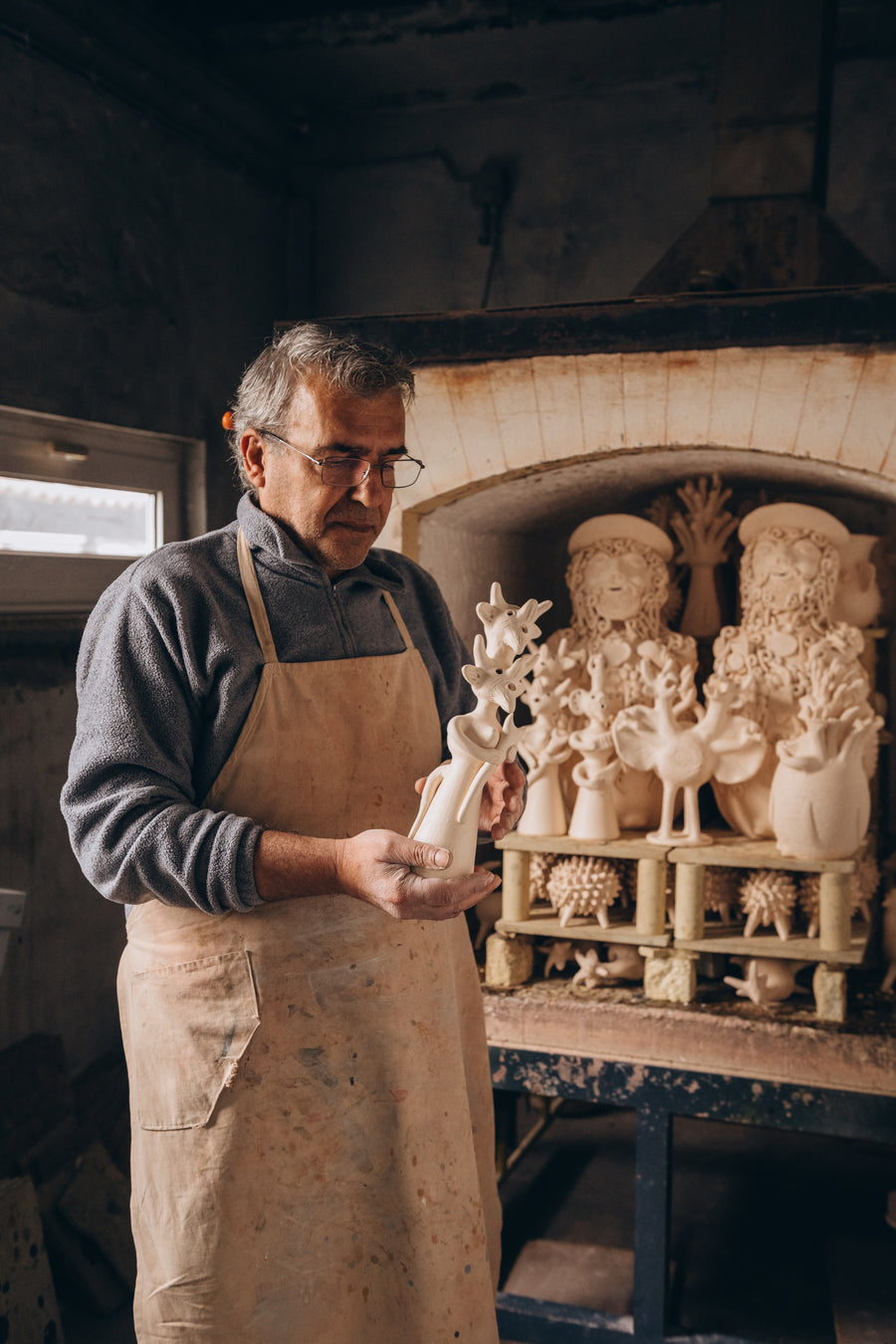
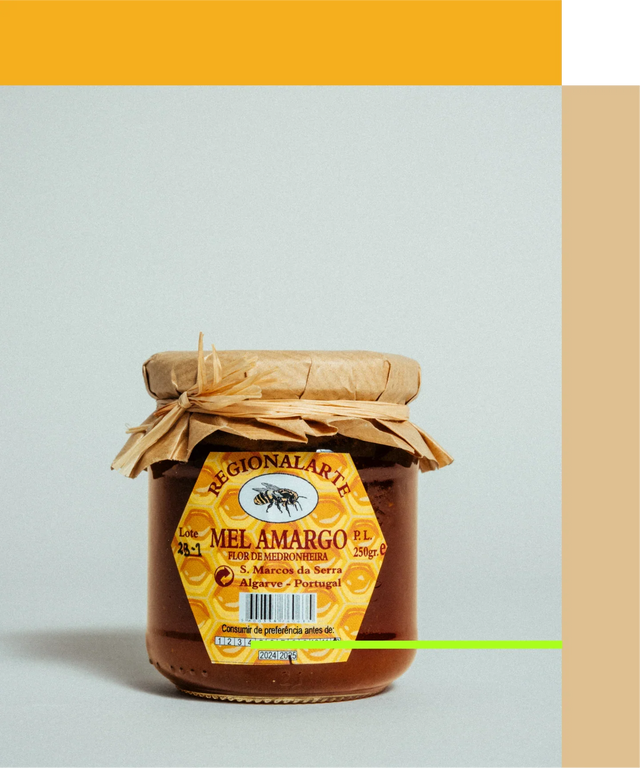
Ours comes from São Marcos da Serra. That is where Jorge Lima and his wife Esmeralda, of Regionalarte, look after 100 hectares of wild strawberry trees overlooking the Odelouca river. Jorge is the fourth generation of a family of distillers, and his eldest daughter, Rute Lima, is already part of the fifth. The fruit goes into the brandy; before that, the flowers go to the bees. I love the idea of one tree giving two harvests, one of nectar and one of fruit.
What does bitter honey taste like, and why does it crystallise so fast?
Bitter honey tastes sweet first and bitter afterwards, with notes that recall coffee. Regionalarte's description is the closest to what I feel: very sweet at first, it quickly turns into a more complex flavour, with a dark brown and golden colour. Reference sources also mention aromas of ivy leaves, coffee grounds, cocoa, rhubarb and gentian, and UNAAPI compares it to chicory and wet tobacco leaf.
It also crystallises quickly, with fine crystals, and becomes soft and creamy. That is not a flaw, it is how this honey normally behaves. If the jar turns lighter and thicker over time, all is well. The table sums up what to expect:
| Feature | What to expect |
|---|---|
| Colour when liquid | Amber to dark brown |
| Colour when crystallised | Hazelnut to brown, with greyish or greenish tones |
| Aroma | Ivy leaf, coffee grounds, cocoa, rhubarb, gentian |
| Taste | Sweet at first, bitter and lingering at the end |
| Texture | Crystallises quickly and turns creamy |
| Flowering season | October to January |
How do you use bitter honey in the kitchen?
Bitter honey is used in small amounts, almost like a seasoning. It is not the honey for sweetening everything, it is the honey for contrast. UNAAPI suggests it with sweet, rich cheeses, with bitter vegetables such as artichoke and in coffee, and notes that in Sardinia it goes into traditional nougat. These are my suggestions to start with:
- With cheese: a drizzle over a soft, buttery cheese, with a pinch of Flor de Sal from the Salinas do Samouco on top. Salty and bitter get along very well.
- With bread: on dark toast with butter, for breakfast on a rainy Sunday.
- In coffee: a small spoonful in an espresso, for those who like bitter on bitter.
- In desserts: over cream ice cream or plain yoghurt, where it balances the sweetness.
- In tea: stirred into a hot infusion at the end, for a winter afternoon.
Start with a little. This honey does not ask for heaped spoonfuls, it asks for attention.
How can you tell genuine bitter honey?
Genuine bitter honey really is bitter, dark and quick to crystallise. Before you buy, look for these signs:
- Taste it if you can. If it is only sweet, it is not strawberry tree honey, or it contains very little.
- Read the label: producer, place and type of honey. Be wary of jars with no named producer.
- Check the season. The strawberry tree flowers in autumn and winter.
- Do not confuse it with Mel da Serra de Monchique PDO, which is multifloral and mild.
- Accept crystallisation. In this honey, it is perfectly normal.
- Ask the beekeeper. In the laboratory, floral origin can be confirmed with markers such as homogentisic acid.
At Ra‑Ro, we know who makes ours: the Lima family in São Marcos da Serra, with the strawberry trees right at their door.
What goes well with bitter honey this winter?
If bitter honey opens the autumn, there are other rare things that call for a long table and a fireplace. We gathered several in the new Ra‑Ro winter collection. Here are a few that pair well with this jar:
- Traditional Mead: the fermented honey drink from Licores Serrano, by Artur Aleixo, made in Covilhã with heather honey from the Serra da Estrela. It is not strawberry tree honey, but it is part of the same family. Learn more about mead.
- Elderflower Liqueur: elderflower picked 800 metres above sea level and infused by the same Licores Serrano. Serve it in a small glass, in moderation.
- Cobertor de Papa: thick wool woven by hand in Guarda, on a wooden loom about 300 years old. See what a cobertor de papa is.
- Spiral Basket: palm empreita made in Tavira by women aged between 70 and 80, also from the Algarve.
And medronho brandy? Regionalarte's is sold out. Our glossary entry on medronho brandy explains why it is the pride of Algarve spirits, and the same tree keeps giving us this honey while we wait.
Frequently asked questions
Are bitter honey and strawberry tree honey the same thing?
Yes. Bitter honey (mel amargo) is the popular Portuguese name for strawberry tree honey, also called mel de medronho. Bees make it from the nectar of strawberry tree flowers (Arbutus unedo), which usually open between October and January.
In which months is strawberry tree honey made?
In autumn and winter. The strawberry tree usually starts flowering in October and can keep flowering until January, so that is when, in cold and rainy weather, bees collect the nectar that becomes bitter honey.
Why does bitter honey crystallise so quickly?
That is how this honey naturally behaves. It crystallises quickly, with fine crystals, and becomes soft and creamy. Its colour moves from amber to hazelnut and brown tones. It is not a sign of poor quality.
Where is bitter honey produced in Portugal?
Mainly in the hills of the Algarve and the Alentejo, where strawberry tree woodland is most common, especially the Serra do Caldeirão and the Serra de Monchique. Ra‑Ro's bitter honey comes from São Marcos da Serra, in the Algarve, made by Regionalarte.
How do you use bitter honey?
In small amounts, for contrast: with sweet, rich cheeses, on buttered toast, in coffee, over ice cream or plain yoghurt, or in a hot infusion. The bitterness balances sweet and salty flavours.
Is Mel da Serra de Monchique PDO a bitter honey?
No. Mel da Serra de Monchique PDO is a mild multifloral honey harvested between late May and mid July. Bitter honey is strawberry tree honey, from autumn and winter.