Cart
0
Hammered Copper Plate: the metal reborn in the hands of a young man from Loulé
Nuno Palma, from Loulé, is rescuing the art of hammered copper: he cuts, softens in the fire, shapes and hardens with the hammer, scrubs with sand and polishes by hand.

In this article
 By Sérgio Carvalho, co-founder of Ra-Ro · View profile
About 3 min read

A hammer, a sheet of metal, an afternoon. It seems too little to make an object that lasts a lifetime. And yet it's almost everything you need. The rest is time and stubbornness.
The Copper Plate is a rectangular hammered copper plate made by hand by Nuno Palma, a craftsman born in Loulé, in the Algarve, who, with his brand Da Palma, is saving a traditional craft technique from extinction: shaping and hardening copper sheet by force of the hammer.
Nuno Palma is a rare case. A young man who could have chosen another path and chose a trade almost nobody wanted to carry on. Whoever chooses to continue a craft is exercising two things at once: the freedom to choose and the responsibility to do it well.

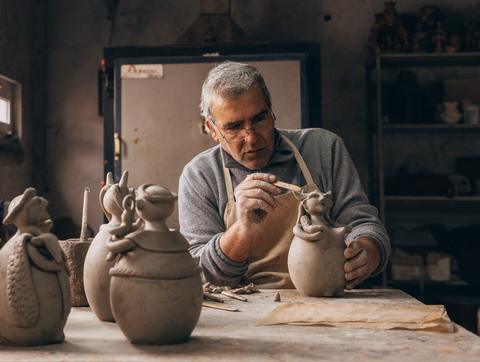
The whole process is his. Nuno Palma cuts the sheets of metal, a lustrous orange-pink, and softens them in the fire. Then the hammer shapes and hardens the sheet. He scrubs it with sand to remove impurities, goes back to the hammer for several rounds and finishes with a final polish.
Hammered copper is copper shaped by successive hammer blows, which give the piece its form and leave an uneven relief on the surface, always different. No two plates are alike.
Table or wall? The choice is ours. On the table, with fruit or bread. On the wall, catching the afternoon light. Copper gains character with time, and that is a kind of use too.
What do we lose when a craft like this disappears: the technique, or the patience it used to teach? That's the question we might ask ourselves. In Loulé, at least for now, nobody has to choose.
A hammer, a sheet of metal, many afternoons. My advice is to look at the relief up close. Every mark was a decision.

Frequently asked questions
What is the Hammered Copper Dish from Loulé?
A handcrafted copper dish, worked by hand using the traditional hammering technique. It can be used at the table or hung as a decorative piece.
Who makes this dish and where?
Nuno Palma, a young coppersmith artisan from Loulé, in the Algarve, who revives old techniques that had almost disappeared.
How is it made, step by step?
Cutting the sheet, softening over the fire, shaping and hardening by hammering, scouring with sand and final polishing. Each piece receives hundreds of hammer blows.
Why is it rare?
It rests on a coppersmithing craft that had almost disappeared, and no two dishes are alike, since each one carries hundreds of different hammer marks.
What material and dimensions does it have?
It is made entirely of copper. It is about 30 cm long, 25 cm wide and 5 cm high.
How do you care for and clean the copper?
Wash it by hand with warm water and soap, avoid abrasives and dry it well. Copper develops a patina; you can restore its shine with a dedicated product or a paste of lemon and salt.



 Autumn
 -10%Packs
 Regions