Cart
0
Banana fibre: what it is, how it is made and what is crafted from it in the Azores
Each banana plant fruits only once. Afterwards the stem can become fibre, and the fibre basketry. How it is done on São Miguel, in the Azores, and how to care for the pieces.

In this article
 By Tiago Reis, co-founder of Ra-Ro · View profile
About a 4 minute read

Banana fibre is the natural fibre taken from the stem of the banana plant after it has produced its one and only bunch. Instead of being thrown away, the stem is split into strips, dried and prepared for weaving, sewing or crochet. On São Miguel, in the Azores, MUSAZ turns this farm waste into handmade baskets, coasters and other objects.
Banana fibre in short
- Where it comes from: the stem of the banana plant, cut after the harvest.
- Why: each banana plant fruits only once; the rest of the plant used to be waste.
- What it is like: light, strong fibre in natural tones from beige to brown.
- What it is used for: woven and sewn basketry, crochet, paper and textile pieces.
- At Ra-Ro: baskets and coasters by MUSAZ, from São Miguel, from 35.70 euros.
Why a banana plant fruits only once
The banana plant looks like a tree, but it is a herbaceous plant of the genus Musa. What we call the trunk is a false stem made of tightly rolled leaf layers. Each plant produces a single bunch of bananas. After the harvest, the stem is cut to make room for a new shoot. For a long time it was left to rot on the ground. That is where the fibre comes from.
How the fibre is extracted and worked
- Cutting: after the harvest, the stem is cut and the layers separated.
- Extraction: the layers are opened into strips and scraped to remove pulp and water.
- Drying: the strips air dry until they are light and flexible.
- Preparation: the fibre is cut, twisted or braided depending on the piece.
- Making: it is coiled and woven, sewn by hand or worked in crochet.
MUSAZ, on São Miguel
Vanessa Melo is an architect with a PhD in urban planning and a researcher. In 2022, with friends and family, she began collecting banana stems from gardens on São Miguel and experimenting with extracting, drying and shredding their fibre. That project led to the book Uma Viagem ao Centro da Bananeira and, in 2025, to the MUSAZ brand. Besides making pieces, MUSAZ runs workshops for older people, children and visitors so the knowledge passes to more hands.
- Crochet Coaster, 35.70 euros.
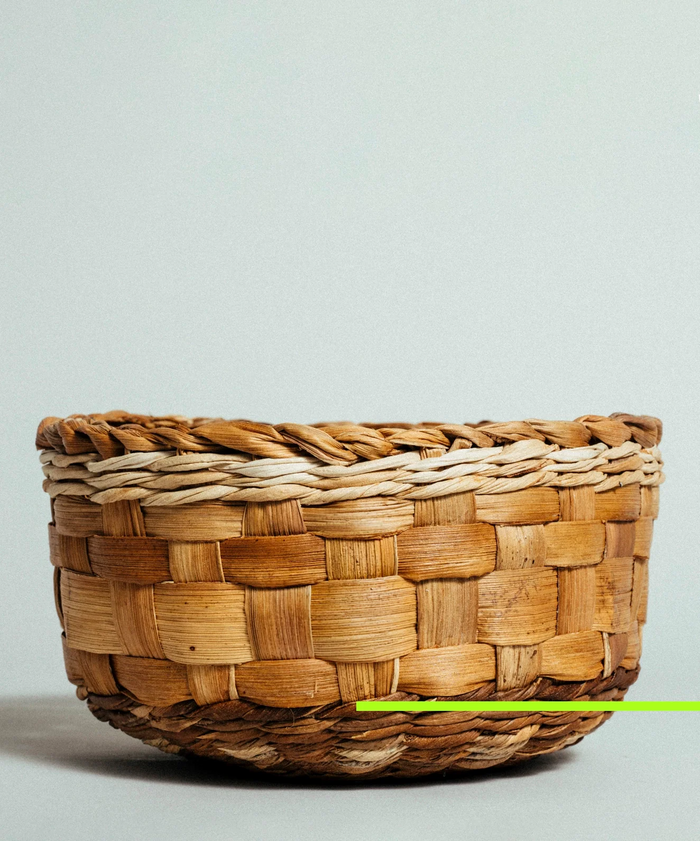
- Small Round Woven Basket, 57.80 euros.
- Woven Basket with squares, 87.30 euros.
- Sewn Basket, 153.80 euros.
- Banana Fibre Pack and Banana Fibre Baskets Pack, 10% cheaper than buying the pieces separately.
How to care for banana fibre pieces
- Keep it dry: constant humidity can cause stains; avoid leaving baskets in bathrooms or outdoors.
- Away from strong sun: long exposure to direct light fades the natural colour.
- Cleaning: a dry cloth or soft brush for dust.
- If it gets wet: pat dry with a cloth and let it air dry, away from heat.
- Use: ideal for fruit, bread, throws, potted plants in a closed pot or small objects.
A fibre with an island inside
The Azores have a long basketry tradition, from willow to plant fibres. Banana fibre joins it with a new gesture: giving a second life to what was left over. We show the islands and their basketry in The Azores: a route through the islands and their basketry. If you like natural fibres, see also bunho, the marsh plant woven into rugs and stools.
Frequently asked questions
What is banana fibre?
The natural fibre taken from the banana plant's stem after the harvest, dried and prepared for basketry, crochet, paper and textile pieces.
Why use the banana stem?
Because each banana plant fruits only once and is then cut down. The fibre gives a second life to that leftover, which used to be waste.
Is banana fibre strong?
Yes. It is light but strong, suitable for baskets and everyday objects as long as it is kept dry.
How do you clean a banana fibre basket?
With a dry cloth or a soft brush. If it gets wet, pat it dry and let it air dry away from heat.
Where is Ra-Ro's banana fibre basketry made?
On São Miguel, in the Azores, by MUSAZ, founded by Vanessa Melo.
Where can I buy banana fibre baskets?
At Ra-Ro, with baskets and coasters by MUSAZ, handmade on São Miguel, shipping to Portugal, Europe, the USA, Canada and Brazil.
 Autumn
 -10%Packs
 Regions