Cart
0
António Ramalho and the clay figures of Barcelos: five pieces by Rosa Ramalho's great-grandson
António Ramalho is a potter from Barcelos, great-grandson of Rosa Ramalho and son of Júlia Ramalho. Discover the story of the Barcelos clay figures and his five pieces at Ra-Ro.

In this article
 By Luís Serra, co-founder of Ra-Ro · View profile
About a 6 minute read

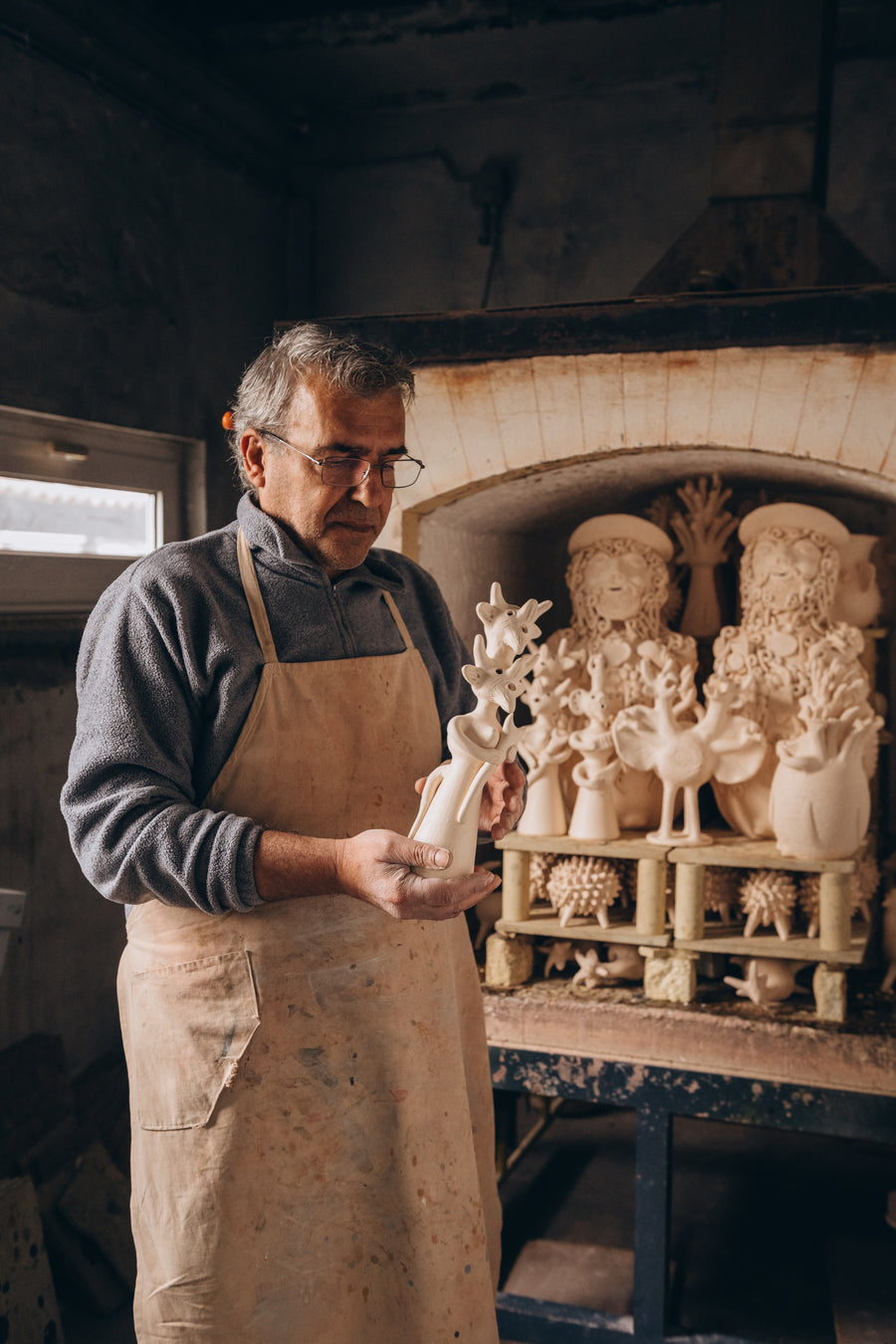
António Ramalho is a potter from Barcelos, great-grandson of Rosa Ramalho and son of Júlia Ramalho, the clay modellers who made the Barcelos figures famous in Portugal and beyond. He learnt the craft at home and found his own language in England and France: liquid colours, a glassy texture and an open taste for the profane and the bizarre. Ra‑Ro works directly with him and sells five of his pieces.
António Ramalho at a glance
- Who he is: a potter from Barcelos, in Minho, the third generation of the Ramalho family.
- Family: great-grandson of Rosa Ramalho (1888 to 1977) and son of Júlia Ramalho.
- Style: the fantastical bestiary of Barcelos, with intense glazes and shiny surfaces.
- At Ra‑Ro: Sarronco, Barcelos Devil, Medusa, Parideira and Hedgehog, from €53 to €157.90.
In Barcelos, nobody called the bogeyman the bogeyman. They called him Sarronco. It was the name António's mother used whenever mischief got the upper hand. António never knew what he looked like. Years later, he gave him a face in clay.
What are the Barcelos clay figures?
The figurado de Barcelos is the tradition of hand-modelled clay figures from the municipality of Barcelos, in northern Portugal. Production was historically concentrated in the parishes of São Martinho and Santa Maria de Galegos, on the right bank of the river Cávado. It was added to Portugal's National Inventory of Intangible Cultural Heritage on 10 July 2026, with around 50 active artisans, and in September 2026 it received EU protection as a geographical indication for craft products.
The themes fall into four groups: religion and festivals, the bestiary (real and fantastical animals, monsters, devils), everyday life, and assorted figures and miniatures. António Ramalho's pieces live mostly in the bestiary.
Three generations of clay in Galegos
Rosa Ramalho (Galegos, 1888 to 1977) is the great name of this tradition. She modelled Christs, saints and shrines, but became known for her devils, beasts and hybrid creatures, such as werewolves and men with donkey heads. In the 1950s the painter António Quadros helped take her work beyond Barcelos.
Júlia Ramalho carried on the family's work, and it was from her that António learnt.
António Ramalho grew up with a question: where does his work fit, next to the women who taught him everything? His answer was to step far enough away to find his own voice. He keeps the family bestiary but swaps traditional colours for intense glazes. Rosa's and António's aesthetic, between the sacred and the profane, inspired the Portuguese animated feature film My Grandfather's Demons by Nuno Beato.
António Ramalho's five pieces at Ra‑Ro
All are hand-modelled in Barcelos clay, glazed, and rated Raríssimo on the Ra‑Ro Rarity Index, the fourth of five levels.
Sarronco (Bogeyman), €157.90
António's most colourful figure to date, about 23 cm long and 19 cm high. Legs in speckled green glaze, a yellow and ochre base, a body with shiny black reliefs and red drops. He should be scary, yet he looks like he would join the children's games straight away.
Barcelos Devil, €79.50
The devil is the figure most associated with Rosa Ramalho. António, who does not call himself religious, made his own as a tribute to his great-grandmother, with different colours and texture. Look at the spikes, the gaze and the snakes.
Hedgehog, €63.40
Curled into a circle, with spines that warn rather than attack. The quietest piece of the set: it asks to be looked at carefully, without touching.
Medusa, €53
Snakes instead of hair, as the myth says. Medusa was first created by António's mother and is now made by him, with the glaze that is his signature. Greek-Barcelos mythology that makes you smile instead of turning you to stone.
Parideira, €53
Many mythologies say humankind was born from clay. Parideira is a tribute to birth: of the flesh and of an idea. It is the piece that moves furthest from the religious tradition of the figures.
How to recognise authentic Barcelos clay figures
- Modelled by hand: hand modelling is the main technique of the tradition. Every piece is slightly different.
- Made in Barcelos: the defined area is the whole municipality, with its historic core in Galegos.
- A named maker: these figures are signed art and the maker's name matters. At Ra‑Ro, every piece is bought directly from the artisan.
Care: handle with care, avoid sudden changes in temperature and dust with a dry cotton cloth or a soft brush.
For more handmade pieces from all over the country, see our guide to Portuguese handicrafts by region.
Frequently asked questions
Who is António Ramalho?
A potter from Barcelos, great-grandson of Rosa Ramalho and son of Júlia Ramalho. He makes Barcelos clay figures with liquid colours and a glassy texture.
What is the Sarronco?
It is the name for the bogeyman in Barcelos. António Ramalho turned him into a clay figure, the most colourful in his work.
What are the Barcelos clay figures?
Hand-modelled clay figures from the municipality of Barcelos, centred on Galegos. Themes range from religion and festivals to a bestiary of devils and monsters.
What is the link to Rosa Ramalho?
Rosa Ramalho (1888 to 1977) was the best-known clay modeller of Barcelos. António is her great-grandson, and his Barcelos Devil is a direct tribute to her.
Are all the pieces the same?
No. They are modelled by hand, so each piece varies slightly.
Does Ra-Ro ship outside Portugal?
Yes. Ra-Ro ships to Portugal, the rest of Europe, the USA, Canada and Brazil, with 30 days for free returns.