Cart
0
Black Clay Cruet: the smoke that keeps an art of Gondar alive
The black clay cruet from Gondar is born from the soenga, an open-air firing that since the 17th century has given the clay its colour. Meet César and João Teixeira.

In this article
 By Tiago Reis, co-founder of Ra-Ro · View profile
About 3 min read

Some pieces are explained by their technique. This one is explained by fire. In Gondar, in the Minho, the clay isn't fired in closed kilns. It's fired in the open air, in pits dug in the ground, wrapped in flames and smoke. When I understood this, the cruet stopped being just a cruet.
The Black Clay Cruet is a cruet made by hand by César Teixeira and his son João, in Gondar, in the municipality of Amarante, shaped on the low wheel and fired by soenga, the technique that gives the clay its deep black.
Who is César Teixeira?
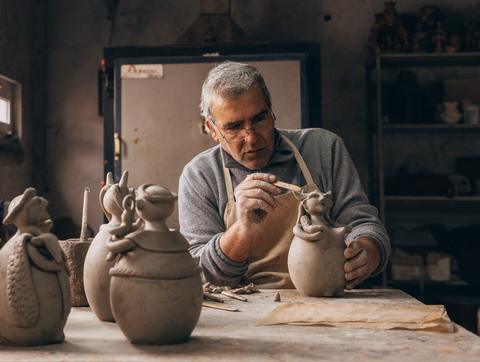
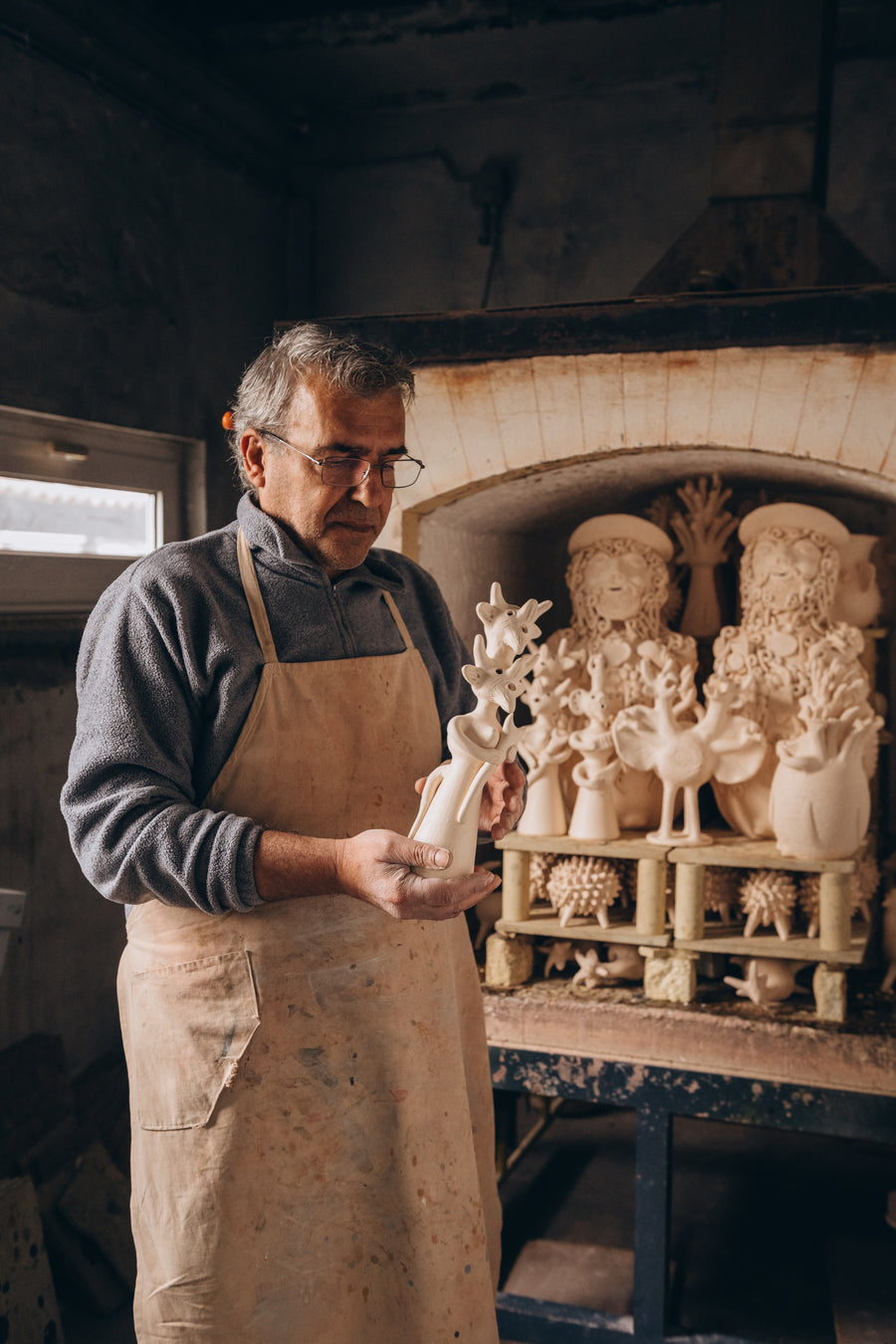
César Teixeira was born in Gondar in 1969 and still lives and works there. At 18 he became apprentice to the master potter Manuel Teixeira and learned two rare techniques he has never let go of: the low wheel and the soenga. Today, with his son João, he is among the last guardians of this pottery.
There's something about this continuity that moves me. A master who taught, an apprentice who stayed, a son who carries on. This cruet has all those hands inside it.

What is soenga?
Soenga is an open-air firing, in pits in the ground, where the pieces are covered in fuel. The fire reaches around a thousand degrees and, at the end, the burn is smothered. Without oxygen, the smoke soaks into the clay and fixes the black tone.
This part fascinated me. The black isn't a paint or a glaze. It's smoke that stayed. And since no two firings are the same, no two cruets are the same either: each one has small variations in colour, texture and shape.
Why does this piece matter?
Because it's useful and beautiful, and that alone would be plenty. It serves olive oil and vinegar at the table, with a silky finish and an almost sculptural presence. But above all it matters because it's know-how at risk, made on the low wheel, slowly, by people who decided not to let it disappear.

Next time someone passes the olive oil at the table, it's worth noticing where that black comes from. It comes from the fire of Gondar.

Frequently asked questions
What is the Black Clay Cruet from Gondar?
A handcrafted black clay cruet, made by hand to serve olive oil and vinegar. Its dark, matte surface gives it a sculptural presence.
Who makes this piece and where?
César Teixeira and his son João, in Gondar, Amarante, in the Minho. They are among the last guardians of this traditional pottery.
What is the soenga technique?
An ancestral method of open-air firing, in pits where the fire reaches around 1000 degrees; the smoke, without oxygen, sets the dark tone.
Why is it a rare piece?
Very few practitioners of this ancestral technique remain, and each firing is different, so each piece shows unique variations.
What are the dimensions?
About 18 cm in diameter and 20 cm in height. The pieces are shaped on the low, manual wheel.
How to care for this piece?
Handle it with care, avoiding drops and sudden temperature changes; dust it with a dry cotton cloth.


 Autumn
 -10%Packs
 Regions