Cart
0
The Barcelos Rooster: the legend, the meaning and how to spot a handmade one
The condemned pilgrim, the roast rooster that crowed and the clay figure that became a national symbol. The legend, the meaning and how to recognise a handmade Barcelos Rooster.

In this article
 By Luís Serra, co-founder of Ra-Ro · View profile
About a 5 minute read

The Barcelos Rooster comes from a medieval legend: a pilgrim on his way to Santiago de Compostela was accused of theft in Barcelos and sentenced to hang. He swore he was innocent and said the roast rooster on the judge's table would crow to prove it. The rooster crowed and the man was saved. Born in the clay figure tradition of Barcelos, the rooster became one of the best known symbols of Portugal in the 20th century, linked to faith, justice and good luck.
The Barcelos Rooster in short
- Origin: a medieval legend from Barcelos, in Minho, tied to the Way of Saint James.
- Meaning: justice, faith, truth and good luck.
- As an object: born in the clay figures of Barcelos, famous since the 20th century.
- Typical colours: dark body, red comb, hearts, flowers and dots painted by hand.
- At Ra-Ro: the cork Barcelos Rooster by Porfírio Mendes, 60.20 euros.
The legend of the Barcelos Rooster
The story is told in several ways, but the core stays the same. A crime had been committed in Barcelos and no culprit was found. A Galician pilgrim, passing through on his way to Santiago, was arrested and condemned. Before being taken away, he asked to see the judge, who was having dinner. He pointed at the roast rooster on the table and said: as surely as I am innocent, that rooster will crow when they hang me. Nobody touched the dish. At the hour of the execution, the rooster stood up and crowed. The judge ran to the gallows and the pilgrim was set free.
Tradition says the pilgrim came back to Barcelos years later and had the Cross of the Lord of the Rooster built. This 14th century stone cross now stands in the Archaeological Museum of Barcelos, next to the Palace of the Counts.
What the Barcelos Rooster means
The rooster is the proof of innocence, so it stands for justice and truth. Because it saved a pilgrim, it also came to mean faith and protection. And because it changed a fate at the last minute, it is given as a good luck charm, especially for new homes, journeys and new beginnings.
How the rooster became a symbol of Portugal
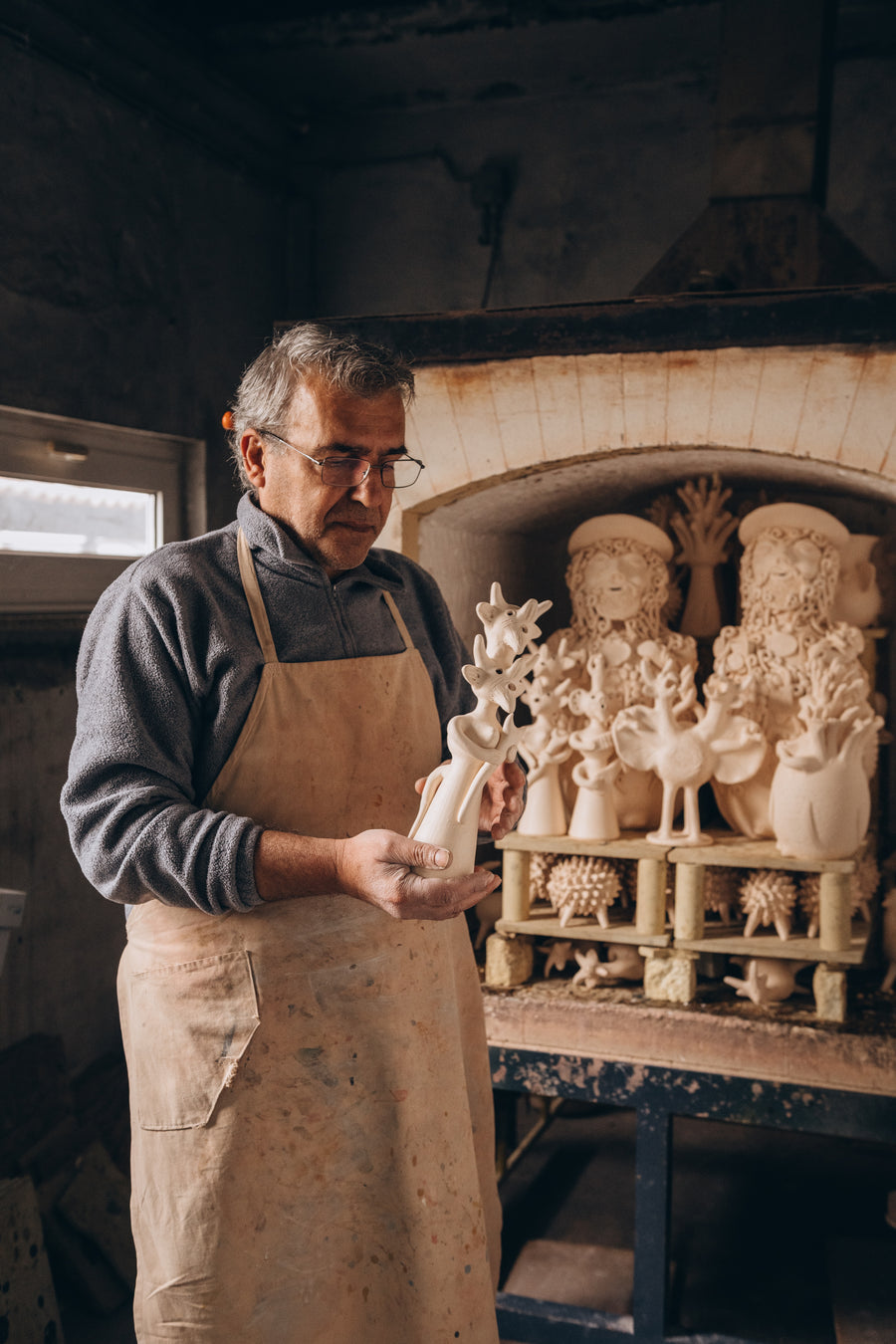
For centuries the potters of Barcelos made tableware, whistles and clay figures for the fairs. The rooster was one of them. In the 20th century, national tourism and propaganda campaigns chose it as the image of Portuguese folk culture, and the rooster moved from the fairs to postcards, tea towels and shops around the world. Barcelos is now a UNESCO Creative City of Crafts and Folk Art, and its weekly Thursday market is still the place to see the clay figures in person.
How to spot a handmade Barcelos Rooster
- Irregular painting: the hearts, flowers and dots differ slightly from piece to piece.
- Weight and material: fired clay or, in Porfírio Mendes' case, carved cork; mass produced copies are often resin or plastic.
- Maker's signature: many figure makers sign underneath.
- Clear origin: the seller should tell you who made the piece and where.
- Price: a handmade rooster costs more than a factory souvenir because it takes hours of work.
Porfírio Mendes' cork rooster
Porfírio Mendes was born in Barcelos in 1967 and has worked in construction since he was 14. In 2013 he discovered cork and began carving roosters, devils, saints and witches from corks collected in restaurants, using a knife, sandpaper, glue and paint. His Barcelos Rooster keeps the red comb and the traditional colours, but swaps clay for cork. By the same maker there is the Rooster Man, a rooster with arms, a waistcoat and a drum, ready for the village festival, and a cork Saint Anthony.
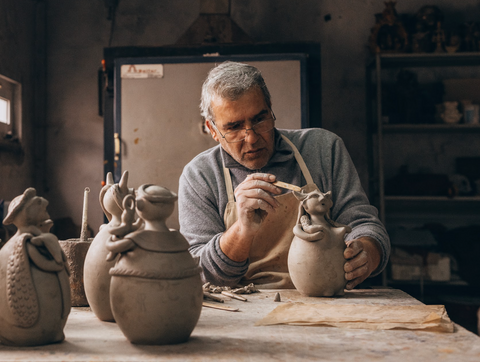
If you prefer clay, the Barcelos Myths Pack brings together two pieces by António Ramalho, great-grandson of Rosa Ramalho. Learn more about the clay figures in António Ramalho and the Barcelos figures and about the darker side of the tradition in Devils, Sarroncos and Mafarricos.
Frequently asked questions
What is the legend of the Barcelos Rooster?
A pilgrim accused of a crime in Barcelos was sentenced to hang and said the roast rooster on the judge's table would crow to prove his innocence. The rooster crowed and the pilgrim was saved.
What does the Barcelos Rooster mean?
Justice, truth, faith and good luck. It is often given as a charm for new homes and new beginnings.
Where is the Barcelos Rooster from?
From Barcelos, in Minho, in the north of Portugal, home of the clay figure tradition.
How can I tell if a Barcelos Rooster is handmade?
The painting has small irregularities, the material is clay, wood or cork rather than resin, the piece often carries the maker's mark and the seller tells you who made it.
Where can I buy a handmade Barcelos Rooster?
Ra-Ro sells the cork Barcelos Rooster by Porfírio Mendes, handmade in Barcelos, shipping to Portugal, Europe, the USA, Canada and Brazil.
 Autumn
 -10%Packs
 Regions